

 0812 46 37 27



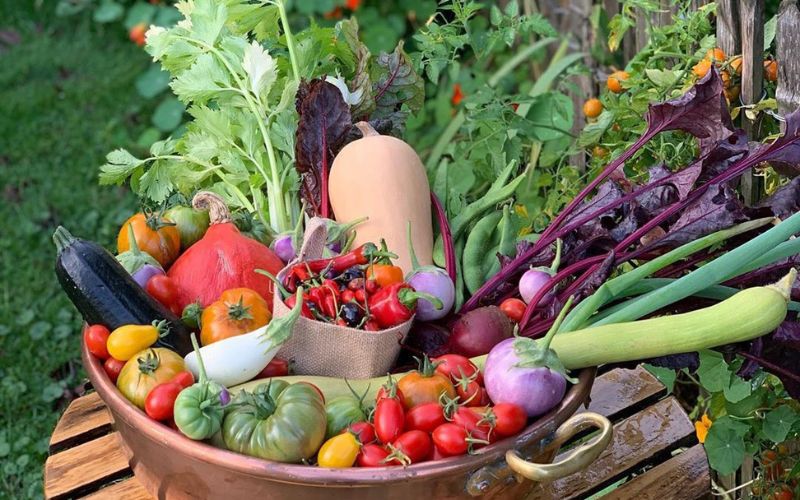
For eateries, restaurants, and F&B kitchens that use a variety of seasonal vegetables, the challenge is not only finding good prices but also ensuring a stable supply, consistent quality, and timely replacements when the market fluctuates. Evaluating suppliers from the outset will help mitigate the problem of “day”Good one day, bad the next,” unexpected shortages of goods, or changes in specifications without prior notice.
Why is it often difficult to ensure a stable supply of seasonal vegetables?
For many eateries, restaurants, and central kitchens, the inconsistency in vegetable availability, inconsistent quality, or constantly fluctuating prices is a year-round problem. This is especially common with certain types of produce. Seasonal vegetables and fruits are in high demand, with supply heavily dependent on weather, harvest yields, and transportation conditions. From the growing region to the point of distribution.
Just heavy rain, prolonged heatwaves, or a sudden increase in logistics costs can immediately disrupt the supply chain. There are times when this happens. Even with the same type of vegetable, the size, freshness, or color can vary significantly between shipments. This makes it difficult for the kitchen to maintain consistent food quality. In addition, the prices of seasonal vegetables often fluctuate sharply during peak seasons or periods of scarcity.
In reality, not all vegetables can maintain consistent quality year-round. Some items remain continuously available, but their specifications and uniformity will vary seasonally. If suppliers don’t proactively update stock levels or offer suitable alternatives, the kitchen can easily be caught off guard when supplies run out during rush hour.
Therefore, for F&B kitchens, a stable supply of vegetables is not simply about “having every item available year-round.” More importantly, the supplier must be able to quickly update inventory status, advise on suitable substitutes, and maintain the highest possible quality of ingredients to avoid disrupting kitchen operations.
How to check if a supplier has a stable supply of fruits and vegetables year-round.
When choosing a vegetable supplier for an F&B kitchen, it’s not just about good prices or fast delivery, but also about the ability to maintain a stable supply over the long term. To minimize shortages, changes in specifications, or inconsistent quality, businesses should carefully examine how suppliers operate and manage their product portfolios from the outset.
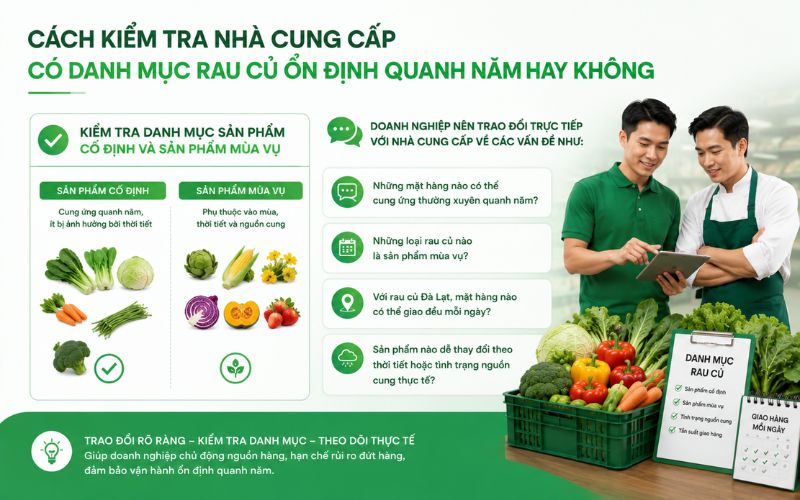
Check the list of fixed and seasonal products.
One of the simplest ways to assess the stability of supply is to ask which goods can be available year-round and which are seasonal.
Businesses should communicate directly with suppliers about issues such as:
- Which items can be supplied regularly throughout the year?
- Which vegetables are seasonal products?
- Which vegetables from Da Lat can be delivered consistently every day?
- Which products are most susceptible to changes due to weather or actual supply conditions?
Clearly separating regular and seasonal ingredients will help the kitchen proactively create menus, control dish costs, and minimize the risk of ingredient shortages during peak seasons.
Clearly define product specifications.
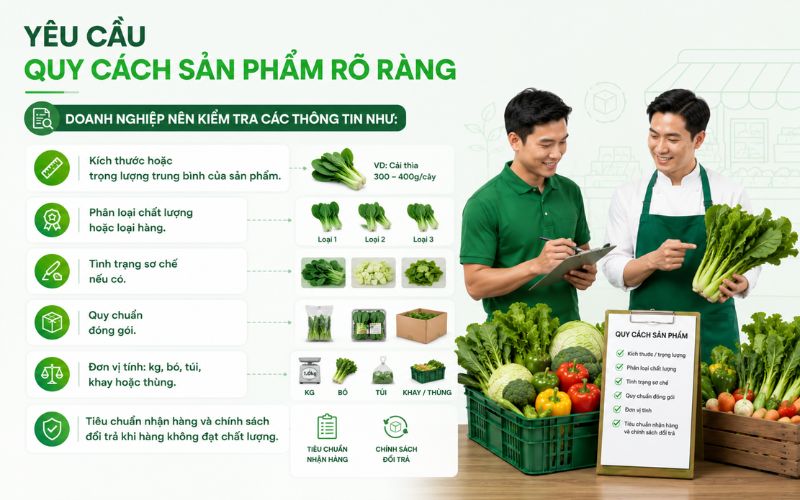
A professional supplier needs to have clear and consistent product specifications across deliveries. This helps the kitchen control the quality of incoming goods and reduce losses during the preparation process.
Businesses should check information such as:
- Average size or weight of the product.
- Classification by quality or type of goods.
- Pre-processing status, if any.
- Packaging standards.
- Units of measurement: kg, bundle, bag, tray, or carton.
- Acceptance standards and return policy for unsatisfactory goods.
If specifications are not standardized from the start, the kitchen can easily encounter situations where the same product is delivered with different sizes, freshness levels, or spoilage rates each time.
Monitor quality through multiple trial deliveries.
You shouldn’t judge a supplier based solely on their first order. In many cases, the initial shipment may be well-prepared, but the quality of subsequent deliveries can be inconsistent.
The restaurant should track at least a few deliveries to check:
- Is the quality of the vegetables consistent?
- Were the goods delivered in accordance with the specifications agreed upon?
- How often are items out of stock or returned?
- Is the delivery time stable and on schedule?
Monitoring actual operations will help businesses accurately assess their ability to maintain long-term supply, rather than relying solely on initial price quotes.
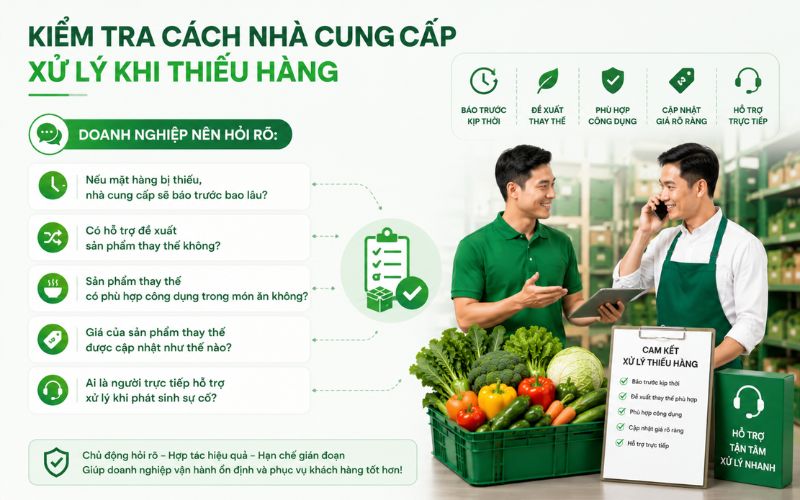
Check how the supplier handles stock shortages.
This is one of the most important but often overlooked criteria when choosing a vegetable supplier for the F&B industry. In reality, seasonal shortages are unavoidable. What matters is how the supplier handles and supports the kitchen when problems arise.
Businesses should ask clearly:
- If an item is out of stock, how much notice will the supplier give?
- Is there support for suggesting alternative products?
- Is the substitute product suitable for the intended use in the dish?
- How is the price of the replacement product updated?
- Who is directly responsible for handling incidents when they occur?
A reliable supplier isn’t one that “never runs out of stock,” but rather one that can quickly update supply status, handle situations flexibly, and help the kitchen maintain stable operations even when the market fluctuates.
Checklist for evaluating vegetable suppliers for F&B businesses.
To select a stable and suitable vegetable supplier for their operating model, F&B businesses should establish a clear evaluation checklist from the outset. Checking against specific criteria will help restaurants minimize the risk of shortages, reduce quality discrepancies, and optimize the long-term procurement process.
| Criteria | Questions to be checked | Why is it important? |
|---|---|---|
| Product catalog | Are there any items that are available year-round? | Help the kitchen maintain a stable menu and proactively plan its inventory. |
| Seasonal products | Are there any seasonal announcements or product alternatives? | Reduce the risk of product shortages or unexpected menu changes. |
| Specifications | Is the size, unit of measurement, and packaging clearly described? | Reduce discrepancies upon receipt and minimize processing losses. |
| Quality | Is the quality consistent across multiple deliveries? | Helps control food quality and customer experience. |
| Delivery | Is delivery consistent with the kitchen's schedule? | Ensure that daily operations are not interrupted. |
| Support arising | Are there staff available to assist with stock shortages or incorrect deliveries? | Help the kitchen staff quickly handle any situations that arise during operating hours. |
| Expanded catalog | Are there any additional meats, fish, drinks, dried goods, or other ingredients? | Reduce the number of suppliers to manage and optimize the purchasing process. |
Kamereo – The optimal wholesale solution for vegetables, fruits, and F&B food supplies for restaurants and eateries.
In the context of frequently fluctuating seasonal supply of vegetables and F&B products, many businesses need not only a reliable source of supplies but also a partner capable of supporting stable daily operations. With its all-in-one model, Kamereo helps F&B businesses optimize their procurement processes, reduce the number of suppliers to manage, and be more proactive when the market changes.
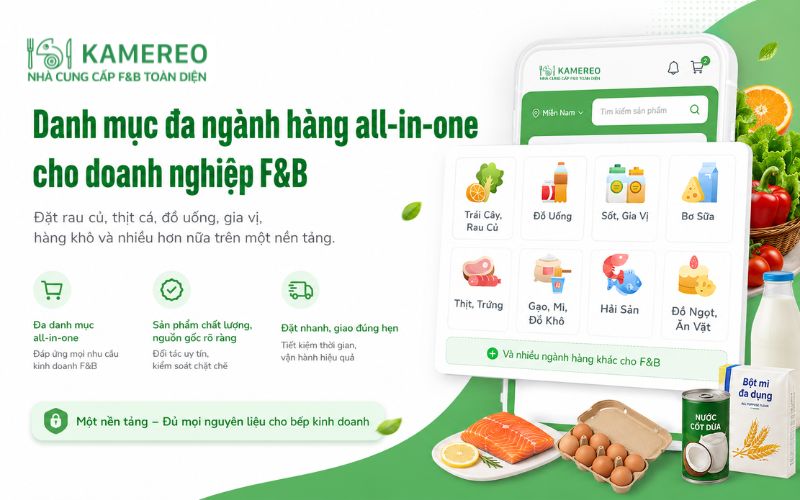
All-in-one multi-category product catalog for F&B businesses.
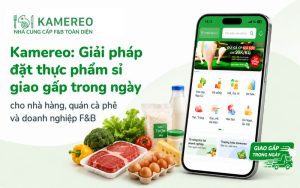
Kamereo offers over 3000+ products across various categories to support F&B operations, including vegetables, meat, fish, beverages, dry goods, spices, and other operational supplies. This helps restaurants, eateries, and cafes reduce the burden of managing multiple suppliers daily.
Instead of working separately with multiple suppliers for each group of raw materials, businesses can centralize order management on a single platform, thereby saving procurement time and optimizing internal operational processes.
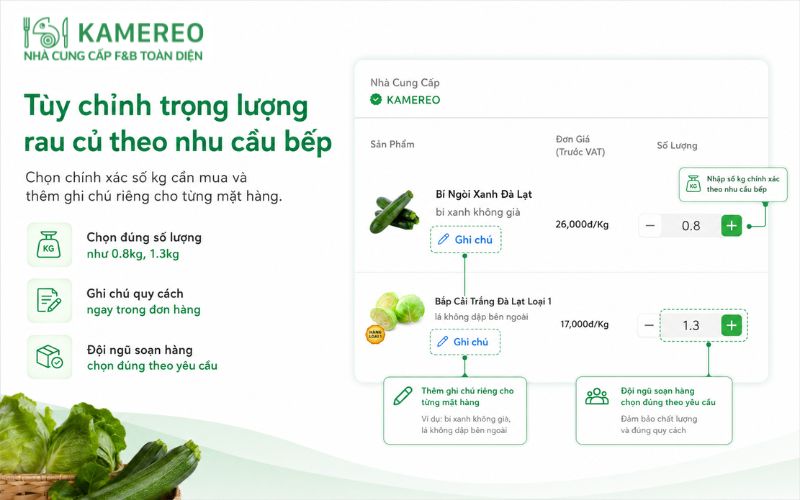
Customize the weight of vegetables.according to clear specifications
When ordering vegetables from Kamereo, businesses can customize the product weight directly on the app or website, instead of having to buy in fixed quantities like 1kg, 2kg, or a whole package. For example, if the kitchen only needs 1.3kg of cabbage or 0.8kg of zucchini, customers can directly enter the desired quantity when placing an order.
Furthermore, Kamereo also supports adding personalized notes to each product in the order. Businesses can leave requests regarding specifications such as: selecting cabbages that are not bruised on the outside, zucchini that are uniformly green, of medium size, and not too old… Based on the weight and notes provided, Kamereo’s packing team will select suitable vegetables before delivery to the customer.
This feature is particularly useful for restaurants, eateries, cafes, and kitchens that operate on a quantitative basis, as it helps to order supplies that closely match daily needs, making it easier to control costs and minimize material waste during processing.
There are seasonal products depending on the time of year.
Depending on the season and actual supply situation, Kamereo may update its product range with seasonal items to suit the needs of F&B businesses.
This gives restaurants and eateries more options when building seasonal menus or needing to change ingredients to suit market conditions. Flexible menu updates also help businesses be more proactive in their operational planning and reduce the risk of sudden shortages.
The customer support team is available to assist you when you need a replacement product.
When certain seasonal items experience fluctuations or temporary shortages, Kamereo has a customer service team that collaborates with the purchasing department and sales staff to provide timely support to customers with suitable alternative products.
Instead of simply indicating “out of stock,” the team will provide updates on supply status and suggest alternative solutions based on the actual needs of each F&B model. This helps kitchens reduce the pressure of finding new sources in a short time and minimize operational disruptions.
The purchasing department and the sales team work closely together.
Kamereo’s distinguishing feature lies not only in its product range but also in the way its operational departments coordinate to support customers throughout the ordering process.
The purchasing, sales, and customer service teams work closely together to update inventory status, monitor supply fluctuations, and advise on suitable products as needed. When changes in supply arise or delivery issues require quick resolution, customers have a clear point of contact to ensure uninterrupted kitchen operations.
Frequently Asked Questions When Finding a Stable Year-Round Vegetable Supplier
Are there any suppliers that consistently have a full range of vegetables available year-round?
In reality, it is very difficult for a supplier to have a full range of vegetables year-round while maintaining absolutely stable quality and prices. The supply of vegetables is always affected by seasonality, weather, harvest yields, and transportation conditions.
Therefore, F&B businesses shouldn’t expect to have “every item in stock at all times.” Instead, they should prioritize suppliers with a stable core product range, clearly updated seasonal products, and suitable alternative options when supply fluctuates.
How can I tell if the daily delivery of vegetables is consistent?
A supplier shouldn’t be judged solely on the first order. Businesses should monitor quality across multiple deliveries to assess the supplier’s actual consistency.
Some criteria to watch for include:
- The freshness and uniformity of the vegetables.
- Does the product meet the specifications as promised?
- Loss rate during initial processing.
- Was the delivery on schedule?
- How suppliers handle stock shortages or deliveries of substandard products.
Continuous monitoring during operation will help the kitchen more accurately assess its ability to maintain a long-term supply.
What criteria should a newly opened restaurant consider when starting to source its supplies?
For newly opened restaurants or cafes, it’s advisable to prioritize checking basic criteria before deciding on a long-term partnership with a supplier.
Here are 5 important criteria to start with:
- Is the core product portfolio stable?
- Are the product specifications clearly stated?
- Is the quality consistent across deliveries?
- Is the delivery capability in line with the kitchen’s operating schedule?
- Do you have a support team to handle issues like missing items or incorrect deliveries?
Early inspections will help the restaurant minimize risks during its initial operating phase.
What should be done if seasonal vegetables are scarce?
Businesses should discuss alternative options for seasonal items with suppliers beforehand, rather than waiting until shortages occur before addressing the issue Kamereo. The customer service team can coordinate with the purchasing department and sales staff to assist customers in selecting suitable replacement products based on their actual needs. This helps the kitchen be more proactive when market supply fluctuates.
Should you choose a supplier that offers a wide range of products instead of just selling vegetables?
Yes, especially for F&B businesses looking to optimize their procurement process and reduce the number of suppliers they need to manage each day. An all-in-one model like this Kamereo. This allows customers to order multiple product categories such as vegetables, meat, fish, beverages, dry goods, and other operational materials on the same platform. This makes order tracking, cost management, and kitchen operations more convenient.
Summary
The supply of seasonal vegetables is stable throughout the year. It’s not about always having a full stock of items, but about the ability to update inventory, maintain quality, and provide timely replacement support for F&B kitchens. With an all-in-one model, Kamereo – We support restaurants, eateries, and cafes in optimizing their procurement processes through a diverse product catalog, clear specifications, and a closely coordinated support team when supply fluctuates.