


 0812 46 37 27




Many restaurant owners, when sourcing ingredients, often focus solely on the wholesale price. However, in practice, issues such as unstable supply chains, delayed deliveries, difficulties with returns and exchanges, lack of invoices, or complex accounts receivable directly impact business operations. Suppliers not only determine the quality of food and beverages but also affect the operational efficiency of the F&B kitchen. Therefore, knowing how to negotiate from the outset will help build long-term partnerships, minimize disputes when problems arise, and create a foundation for sustainable development for both parties. Price is important, but it’s only one part of the negotiation.
Items to be negotiated with suppliers for long-term cooperation.
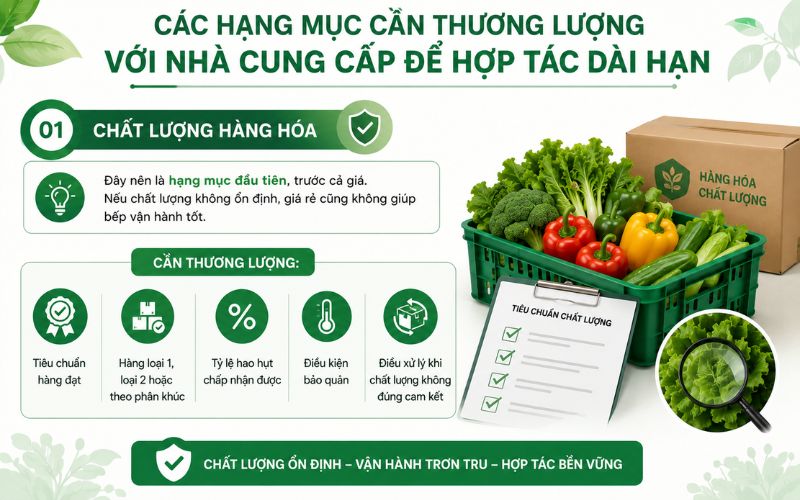
Product quality
Quality of goods should be the first item negotiated, even more important than price. A good price won’t provide much value if the ingredients are inconsistent, causing the quality of food or drinks to vary between servings. This directly impacts the customer experience and the reputation of the F&B establishment.
When communicating with suppliers, the kitchen should clarify the following points to establish a basis for evaluating and controlling quality throughout the collaboration process:
- Product quality standards: Clearly define the criteria for evaluating the quality of raw materials before importing them.
- Goods classification: Determine the appropriate product category (Grade 1, Grade 2, or quality segment) for your business model.
- Acceptable loss rate: Specify the maximum loss rate for each group of raw materials.
- Storage conditions: Clarify storage requirements during transportation and warehousing to ensure quality.
- Handling cases where goods do not meet quality standards: Agree on a policy for exchange, refund, or replacement if the quality does not meet the promised standards.
These provisions help reduce disputes when incidents arise and lay the foundation for a long-term cooperative relationship between the two parties.
Product specifications
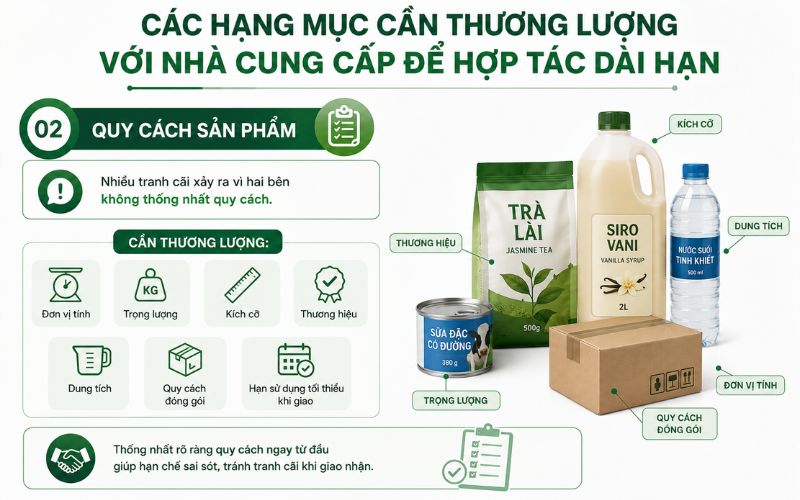
Many disputes between F&B kitchens and suppliers don’t stem from quality issues but rather from differing interpretations of product specifications. Therefore, this is a crucial point that needs to be agreed upon from the outset.
To avoid misunderstandings during the ordering and delivery process, F&B kitchens should agree on the details of product specifications right from the start. Some points to negotiate include:
- Unit of measurement: Clearly identify whether the product is measured in kilograms, packages, boxes, bottles, or trays.
- Weight: Standardize the actual weight of each product unit.
- Size: Specify the dimensions or classification standards for each item.
- Trademark: Clarify which brands or manufacturers are authorized to supply.
- Capacity: This applies to liquid products such as milk, sauces, or beverages.
- Packaging specifications: Ensure consistency in the number of products in each box, tray, or package.
- Minimum expiry date at delivery: The regulations specify a minimum remaining shelf life to ensure quality and facilitate inventory management.
For example, even with beef, the fat content, slice thickness, or weight per tray can vary depending on the supplier. Standardizing specifications from the outset will help minimize disputes and ensure consistent quality of raw materials.
Prices and price update cycles
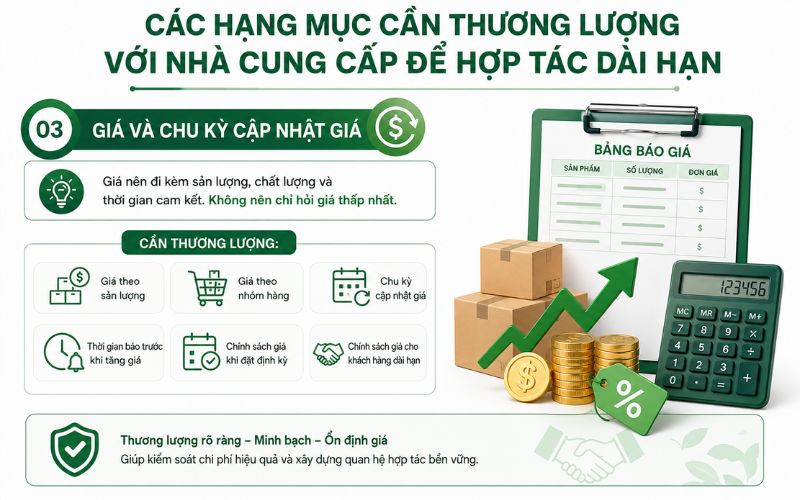
Price is an important factor, but it shouldn’t be the sole content of the negotiation process. A reasonable price should be evaluated in conjunction with the quality of goods, order quantity, and commitment to cooperation between the two parties.
When negotiating prices, the following points should be clarified to avoid misunderstandings during the collaboration process:
- Price based on output: Determine the price level corresponding to each order threshold to take advantage of discounts when buying in bulk.
- Prices by product group: Establish a unified pricing policy for each group of raw materials or products.
- Price update cycle: Regulations specifying the timeframe for periodic price reviews and adjustments.
- Notice period before price increase: Suppliers need to give advance notice so that the kitchen can proactively plan its purchases and adjust prices accordingly.
- Pricing policy for recurring orders: Discounts apply to orders placed on a fixed schedule.
- Pricing policy for long-term customers: Establish customized pricing or benefits packages for long-term partners.
Clearly defining these aspects helps restaurants or eateries better control costs and mitigate risks when the market fluctuates.
Delivery schedule and supply stability
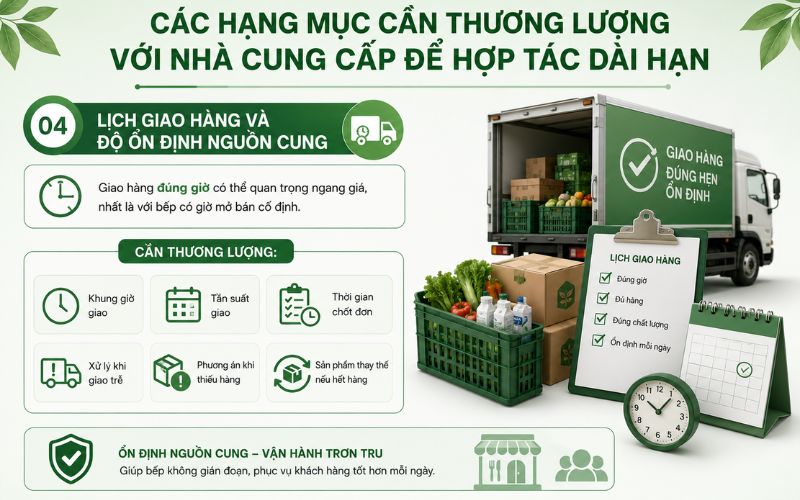
For many F&B kitchens, on-time delivery is just as important as the purchase price. A single late order or a shortage of ingredients during peak hours can impact business for the entire day.
When negotiating delivery schedules and supply sources, the following points should be clearly agreed upon:
- Fixed delivery times throughout the day.
- Delivery frequency (daily, every other day, or on a fixed schedule).
- Order cutoff time allows the supplier time to prepare the goods.
- Procedures for handling late deliveries.
- How to handle stock shortages or insufficient quantities.
- List of alternative products when the main item is temporarily out of stock.
Clarifying these details from the outset will help the kitchen operate proactively, minimize disruptions, and reduce risks during the collaboration.
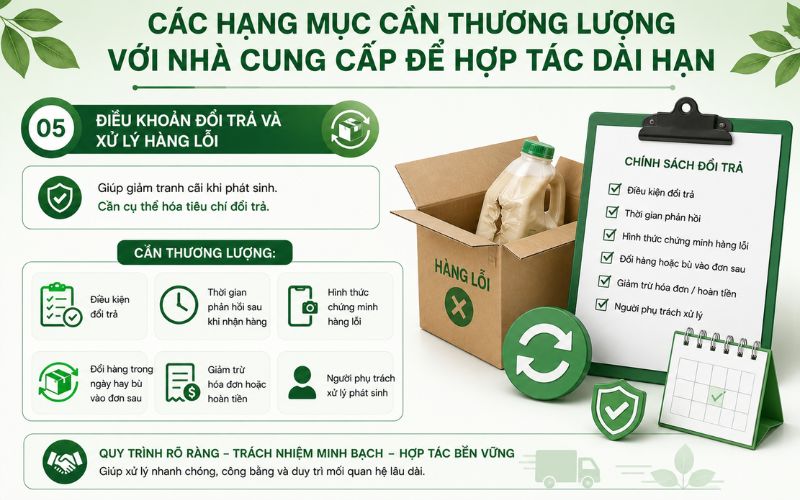
Return and exchange policy for defective goods
Not every order goes perfectly. Therefore, the return and exchange policy is something that needs to be clearly agreed upon from the start to minimize disputes when they arise.
When negotiating terms for returns and handling defective goods, both parties should clearly agree on the following points:
- Return and exchange conditions: Specify the specific circumstances under which exchanges or returns are accepted.
- Response time after receiving the goods: The regulations stipulate a deadline for notification if any problems are discovered with the goods.
- Methods for proving defective goods: Images, videos, or delivery receipts can be used as evidence for processing.
- Proposed solution: Agree on the terms of exchange within the day, replacement in the next order, invoice reduction, or refund.
- Person in charge of handling issues: Designate a point of contact to receive and resolve related issues to avoid delays.
Clearly defining these points from the outset will help make the coordination process more transparent and minimize disputes when incidents arise.
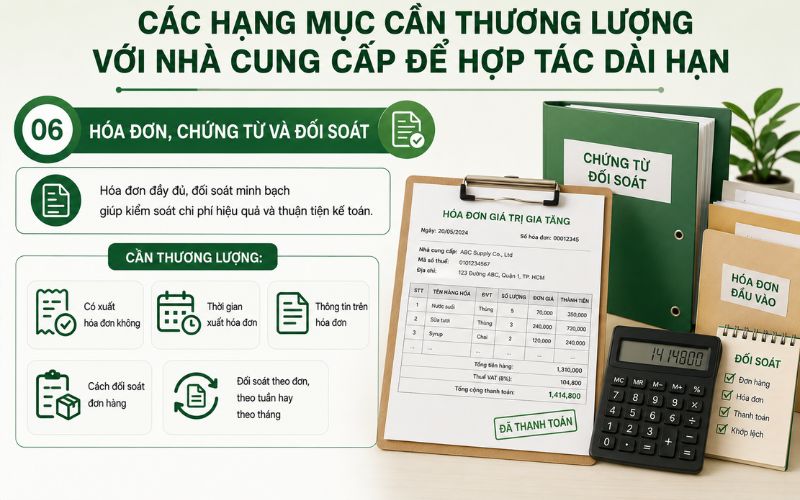
Invoices, supporting documents, and reconciliation.
For restaurants, cafes, or F&B chains, invoices and receipts not only serve accounting purposes but also help control costs and ensure transparency in purchasing operations.
When negotiating invoices, documents, and reconciliation, the following points should be clearly agreed upon:
- Is an invoice issued?: Confirm your ability to provide invoices for each order or for a specific period.
- Invoice issuance time: Clearly defining the time of invoice issuance facilitates accounting and tax declaration processes.
- Information on the invoice: Standardize required information such as business name, tax identification number, address, and product description.
- How to reconcile orders: Define the procedures for verifying quantities, values, and related issues.
- Reconciliation cycle: Standardize reconciliation for each order, weekly, or monthly.To minimize data discrepancies during collaboration.
These features are particularly important for restaurants, F&B chains, or businesses that need to control costs and ensure transparency in their purchasing operations.
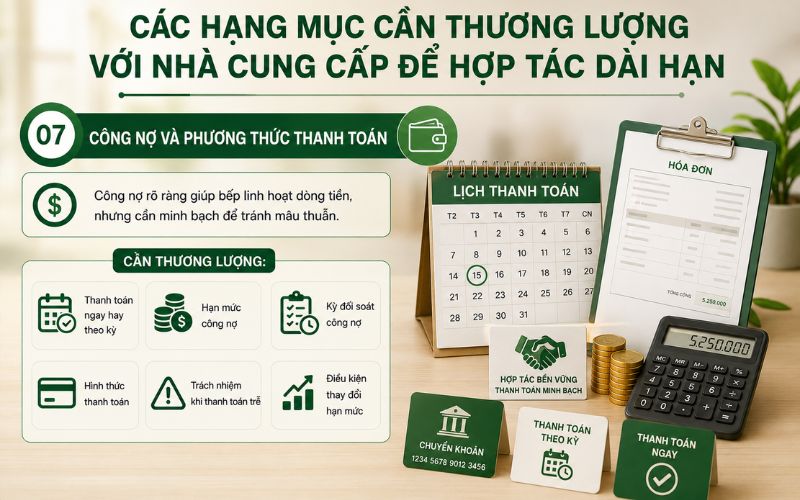
Accounts payable and payment methods
A credit policy can help F&B businesses manage their cash flow flexibly, especially during expansion phases or when maintaining stable inventory levels. However, all terms and conditions need to be clearly and transparently agreed upon to avoid conflicts.
To avoid misunderstandings during the collaboration process, both parties should clearly agree on the following points:
- Payment options: immediate or installments? Determine the payment method that best suits the scale and operational needs.
- Credit limit: The regulations specify the maximum amount of debt that can be incurred.
- Accounts Reconciliation Period: Reconciliation is done weekly, bi-weekly, or monthly.
- Payment methods: Bank transfer, cash, or other forms of payment.
- Responsibilities for late payments: The regulations clearly specify the procedures and related conditions.
- Conditions for changing the credit limit: Determine the criteria for increasing or decreasing credit limits in the future.
Clarifying these terms helps both parties proactively plan their finances and build a stable, long-term cooperative relationship.
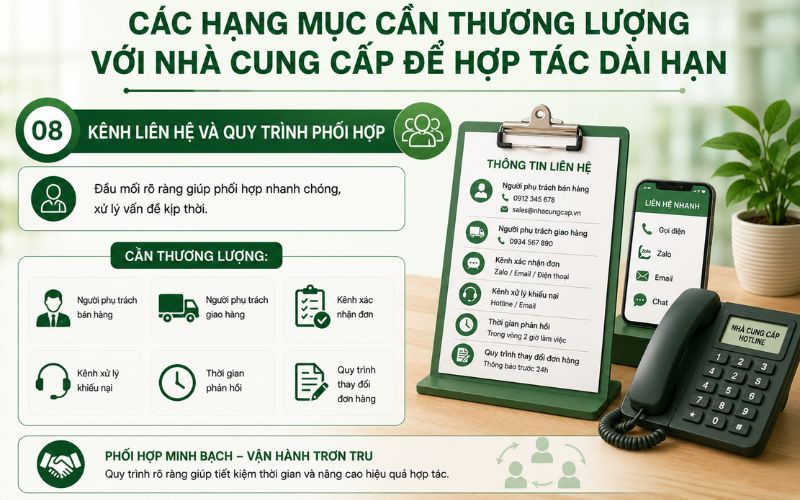
Communication channels and coordination processes
A long-term partnership requires clear lines of communication. When issues arise with orders, deliveries, or product quality, knowing exactly who is responsible allows for faster resolution.
When negotiating the coordination process, it is important to clearly define the contact points and working methods between the two parties:
- Sales representative: The point of contact for receiving orders and assisting with product-related issues.
- Delivery person: Responsible for transportation and updating delivery status.
- Order confirmation channel: Agree on using email, Zalo, or management software to avoid confusion.
- Complaint handling channel: Clearly define the location for receiving and processing any feedback that arises.
- Response time: Determine the maximum response time for requests or incidents.
- Order modification process: Agree on a method for adjusting quantities, products, or delivery times when unexpected needs arise.
Clarifying these points from the outset will help ensure smoother and more effective coordination in the long term.
How to negotiate with suppliers for a win-win situation.
Negotiating with suppliers isn’t about maximizing advantage for one party, but about building a sustainable partnership for mutual growth. If approached correctly, F&B kitchens can not only optimize costs but also secure a stable supply of goods and better support throughout their operations.
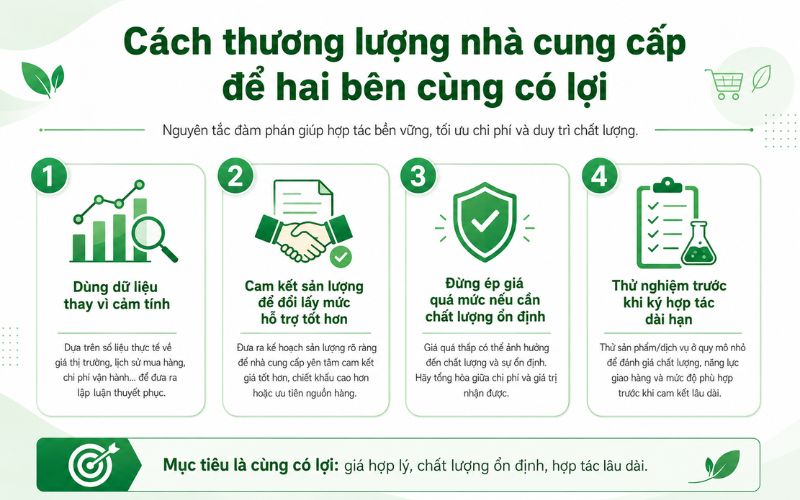
- Use data instead of intuition: Use metrics such as import volume, order frequency, purchase history, or defect rates as a basis for negotiation. This factual data makes the exchange more transparent and increases the likelihood of reaching a mutually beneficial agreement.
- Commitment to production levels in exchange for better support: If the kitchen requires a consistent supply of goods, they can propose committing to a certain production volume for a specified period to receive better pricing, priority delivery, flexible credit terms, or more favorable return and exchange conditions.
- Don’t haggle excessively if you need consistent quality: Focusing solely on low prices can lead suppliers to compromise product quality, reduce delivery priority, or limit support when problems arise. Instead of just looking at the unit price, consider the overall balance between quality, service, and supply chain stability.
- Testing before signing a long-term partnership: Before entering into a long-term agreement, it’s advisable to conduct a trial period of 2-4 weeks to assess the supplier’s product quality, delivery accuracy, return policy, and support capabilities. This is an effective way to reduce risk and make informed decisions about future collaborations.
Sample checklist for negotiating with F&B suppliers.
During the process of searching for and working with suppliers, many F&B kitchens often overlook important terms such as credit terms, returns, delivery schedules, or quality standards. This can lead to unnecessary disputes in long-term partnerships.
To help restaurants, cafes, and central kitchens systematically evaluate suppliers, using a negotiation checklist is an effective solution. This list helps purchasing teams thoroughly check all items that need to be discussed before signing a partnership agreement, from product quality, price, and supply source to invoices and coordination processes.
Download the F&B supplier negotiation checklist now to standardize workflows, minimize risks, and build sustainable partnerships with suppliers.
Common mistakes when working with suppliers
Even after finding the right supplier, many F&B kitchens still encounter problems due to a lack of management processes or incomplete agreement on cooperation terms. Below are common mistakes that restaurants, cafes, and central kitchens should avoid.
Just negotiate the price, ignore the process.
Many restaurant owners spend most of their time negotiating prices but overlook crucial aspects such as delivery schedules, returns, accounts receivable, and procedures for handling unforeseen issues. While this might save costs in the short term, it creates significant operational risks.
A supplier that charges slightly more but delivers on time, provides quick support, and has a stable supply often offers greater value in the long run.
There are no clear quality standards.
If the two parties do not agree on quality standards from the outset, each will have a different way of evaluating the goods upon receipt. This is a common cause of disputes over material quality.
The kitchen should establish specific criteria regarding size, weight, freshness, spoilage rate, or minimum shelf life to serve as a basis for inspection and verification when necessary.
Do not inspect the goods immediately upon receipt.
Many businesses only discover defective or missing items after they have been stored in the warehouse or used. At that point, verifying responsibility and requesting exchanges or returns often becomes more difficult.
Therefore, it is necessary to check the quantity, specifications, quality, and condition of the packaging immediately upon receipt of goods. If any problems are found, they should be documented with photos or a written record so that they can be promptly addressed with the supplier.
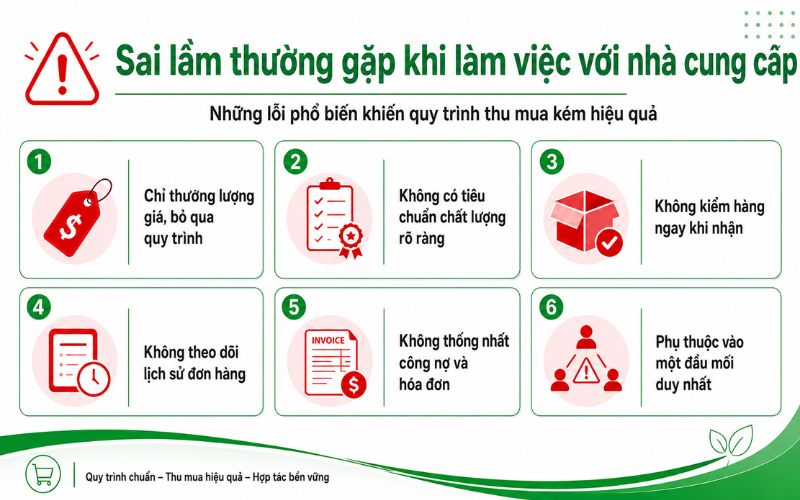
Order history not tracked
The failure to store purchase history makes it difficult for the kitchen to assess the effectiveness of the partnership and eliminates a basis for negotiating better policies in the future.
Tracking order data helps businesses control production volume, order frequency, defect rates, spending levels, and the performance of each supplier. It’s also a crucial data source for negotiating prices and accounts payable.
Inconsistencies between accounts payable and invoices.
Many financial disputes arise because the two parties do not clarify payment terms or invoicing procedures from the outset.
Before collaborating, it’s essential to clearly agree on credit limits, payment terms, reconciliation periods, invoice issuance times, and each party’s responsibilities in case of data discrepancies. This helps mitigate risks and ensures transparency in cost management.
Dependent on a single point of contact.
When the entire ordering and troubleshooting process relies on a single individual, businesses can struggle if that person leaves, transfers to another department, or is unable to provide timely support.
To mitigate risk, there should be at least two points of contact from the supplier, including a sales representative and an operations or logistics manager. This ensures continuous and uninterrupted coordination should any issues arise.
Kamereo – The ultimate wholesale food sourcing app for F&B businesses.
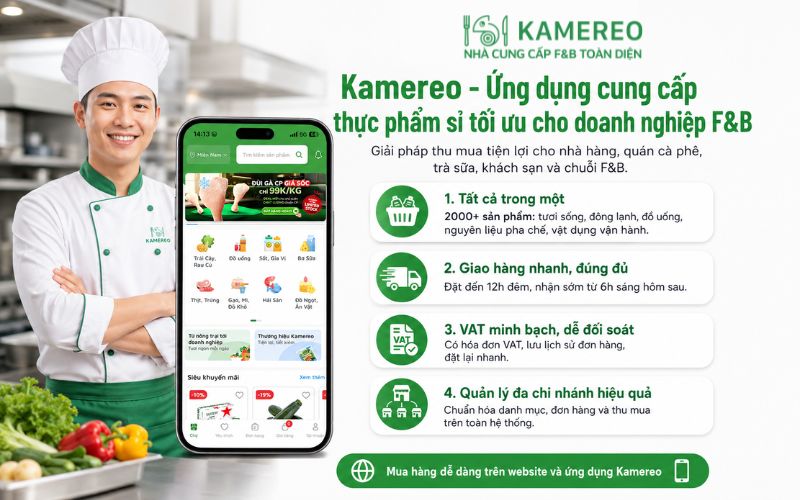
As the F&B industry grows, working with multiple suppliers and managing orders manually can be time-consuming and difficult to control. Kamereo is a wholesale food supply platform that helps businesses centralize supply chain management, orders, and costs on a single system.
- All-in-one supplier: Kamereo offers over 2000+ products, from fresh and frozen foods to beverage ingredients, drinks, and operational supplies, all on a single platform. It’s ideal for restaurants, cafes, bubble tea shops, hotels, and F&B chains looking to simplify their purchasing process.
- Fast and accurate delivery: Businesses can place orders until midnight and receive them as early as 6 a.m. the next day. Centralizing the supply chain through a single point of contact reduces ordering time and simplifies delivery tracking.
- Transparent and easy-to-verify VAT invoices: Kamereo providing VAT invoices and storing purchase history on the system helps businesses easily control costs, track orders, and reorder frequently used products.
- Effective multi-branch management: For F&B chains, Kamereo supports order management across multiple sales points, helping to standardize product catalogs, ordering processes, and procurement operations throughout the system.
Frequently Asked Questions
What should be negotiated with the supplier before starting a partnership?
It’s important to agree on product quality, pricing, delivery schedules, returns, invoices, accounts receivable, and coordination procedures to avoid future disputes.
Why shouldn’t you focus solely on price when choosing a supplier?
Low prices but inconsistent quality or poor delivery can increase operating costs. Evaluate quality, service, and supply chain consistency.
What should the return and exchange policy with a supplier include?
It is necessary to clearly define the conditions for returns and exchanges, response times, methods for confirming defective goods, and procedures for handling issues that may arise.
How can I negotiate prices while maintaining consistent product quality?
Base your decisions on purchasing data and production commitments rather than simply requesting price reductions. This helps maintain better quality and service.
Should we commit to a production quota with our suppliers?
Yes, if demand for goods is stable. Committing to a certain production volume can help secure better prices and more support policies.
When should you switch to a B2B provider like Kamereo?
When purchasing handcrafted goods becomes complicated, involving multiple suppliers or making it difficult to control costs, invoices, and orders.
Do small restaurants need to negotiate bills and accounts receivable?
Yes. Agreeing on terms from the outset helps manage costs, cash flow, and minimize misunderstandings during the collaboration process.
Summary
Negotiating with suppliers involves more than just price; it also requires agreement on quality, delivery, returns, payment terms, and invoices. This helps F&B kitchens control costs, reduce risks, and maintain a stable supply. For businesses looking to professionalize their purchasing and supply chain management, they can consider Kamereo’s B2B solutions.