

 0812 46 37 27



As businesses expand, continuing to purchase beverages retail can lead to high costs, unstable supply chains, and difficulty controlling inventory. Switching to wholesale is a necessary step to optimize budgets, ensure a continuous supply, and enhance competitiveness. In this article, we will provide a detailed roadmap for transitioning from retail to wholesale beverage purchasing, helping chain owners build effective and sustainable procurement plans.
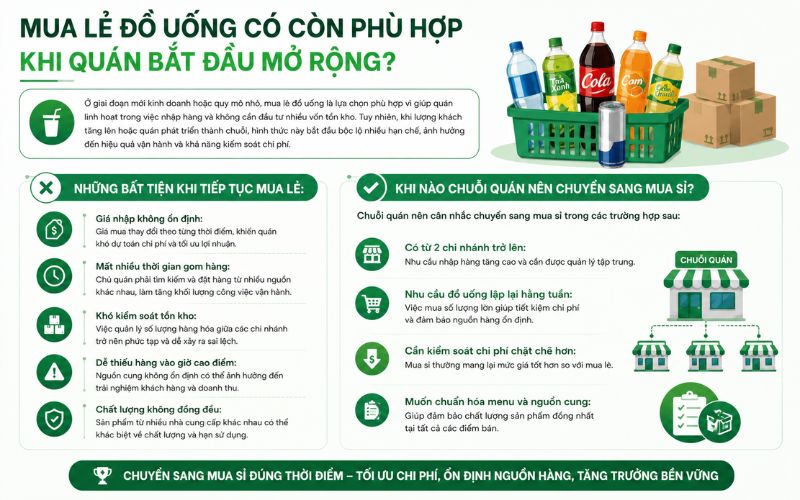
Is buying drinks individually still a good idea as the shop starts to expand?
In the early stages of a business or on a small scale, buying beverages individually is a suitable option because it allows for flexibility in sourcing and doesn’t require significant investment in inventory. However, as customer numbers increase or the business expands into a chain, this method begins to reveal many limitations, affecting operational efficiency and cost control.
The inconveniences of continuing to buy in small quantities.Drinks include:
- Import prices are unstable: Purchase prices fluctuate over time, making it difficult for the restaurant to forecast costs and optimize profits.
- It takes a long time to gather the goods: The owner has to source and order from many different suppliers, which increases the operational workload.
- Inventory control is difficult: Managing inventory levels between branches becomes complicated and prone to errors.
- Goods are easily out of stock during peak hours: Unstable supply can impact customer experience and revenue.
- Inconsistent quality: Products from different suppliers may vary in quality and expiration dates.
When should restaurant chains switch to wholesale purchasing?
Restaurant chains should consider switching to wholesale purchasing in the following situations:
- Having two or more branches: The demand for imported goods is high and needs to be managed centrally.
- The need for recurring beverages on a weekly basis: Buying in bulk helps save costs and ensures a stable supply of goods.
- We need tighter cost control: Buying in bulk usually offers better prices than buying retail.
- To standardize menus and sourcing: Helps ensure consistent product quality across all points of sale.
The roadmap for transitioning from retail to wholesale beverage purchasing for chain stores.
The shift from retail to wholesale should not be made abruptly. Chain restaurants need to develop a clear roadmap to ensure a stable supply, optimize costs, and minimize inventory risks. Below are 7 steps to help make the transition more effective.
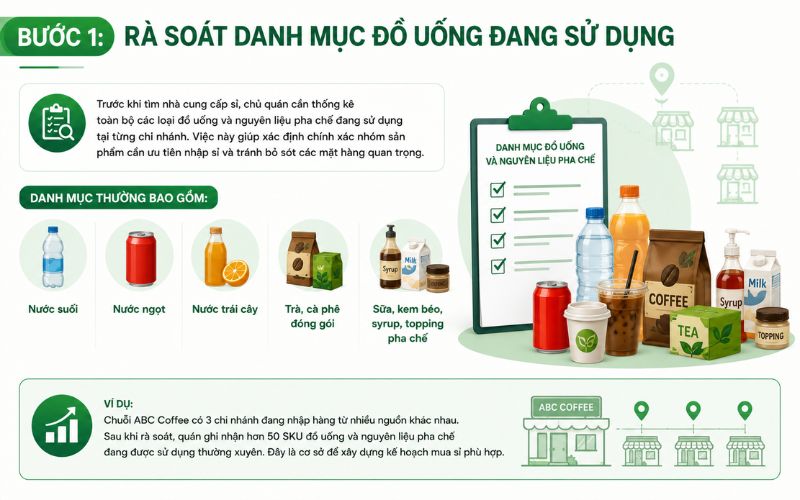
Step 1: Review the list of beverages currently being consumed.
Before finding wholesale suppliers, business owners need to compile a complete list of all beverages and ingredients currently used at each branch. This helps accurately identify the product groups to prioritize for wholesale sourcing and avoid overlooking important items.
The categories typically include:
- Spring
- Soft drink
- Fruit juice
- Packaged tea and coffee
- Milk, heavy cream, syrup, and toppings.
For example: ABC Coffee chain has 3 branches that source their supplies from various suppliers. After reviewing the inventory, the chain identified over 50 beverage and ingredient SKUs that are regularly used. This provides a basis for developing a suitable wholesale purchasing plan.
Step 2: Classify products by frequency of use.
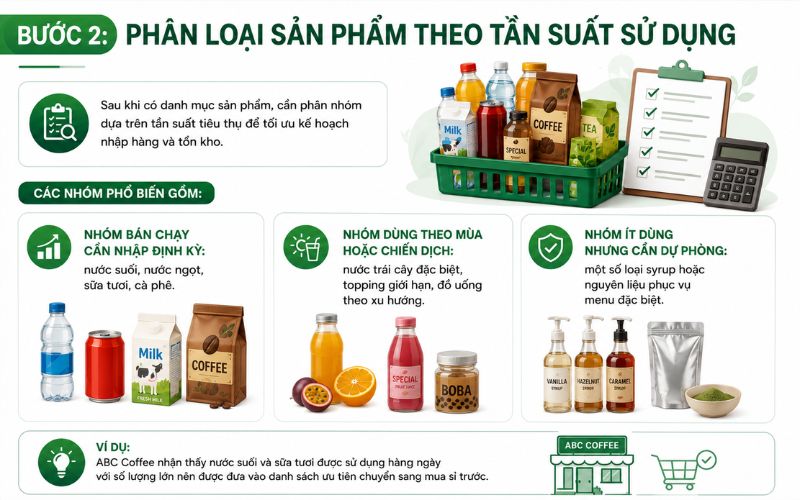
After creating the product catalog, it’s necessary to group products based on consumption frequency to optimize purchasing and inventory planning.
Common groups include:
- The best-selling items need to be restocked regularly: Bottled water, soft drinks, fresh milk, coffee.
- Seasonal or campaign-based usage groups: Specialty fruit juices, limited-edition toppings, trendy drinks.
- Group of items that are rarely used but need to be kept as a backup: Some types of syrups or ingredients are used to serve special menu items.
For example: ABC Coffee recognized that bottled water and fresh milk are consumed in large quantities daily, so they were prioritized for wholesale sourcing.
Step 3: Calculate weekly or monthly consumption volume.
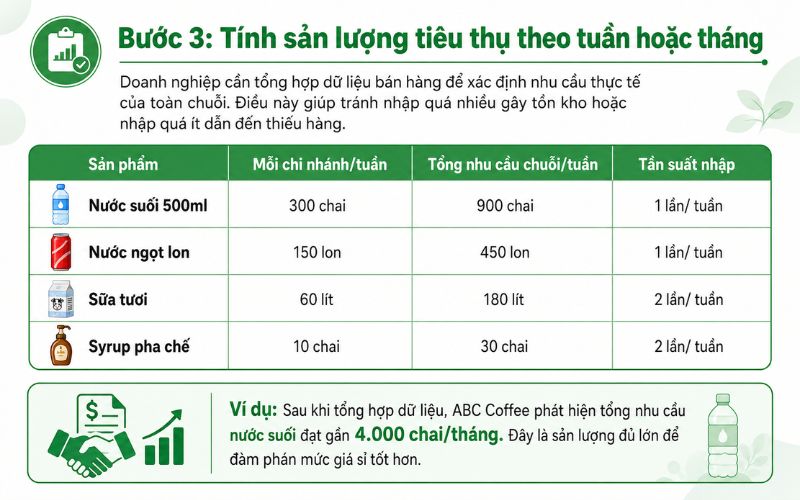
Businesses need to compile sales data to determine actual demand across the entire supply chain. This helps avoid over-ordering, leading to excess inventory, or under-ordering, resulting in shortages.
|
Product |
Each branch/week |
Total chain/weekly demand |
Input frequency |
|
500ml bottled water |
300 chai |
900 chai |
once a week |
|
Canned soft drinks |
150 lon |
450 lon |
once a week |
|
Fresh milk |
60 liters |
180 liters |
2 times/week |
|
Mixed syrup |
10 chai |
30 chai |
2 times/week |
For example: After compiling the data, ABC Coffee discovered that the total demand for bottled water reached nearly 4,000 bottles per month. This is a sufficiently large volume to negotiate a better wholesale price.
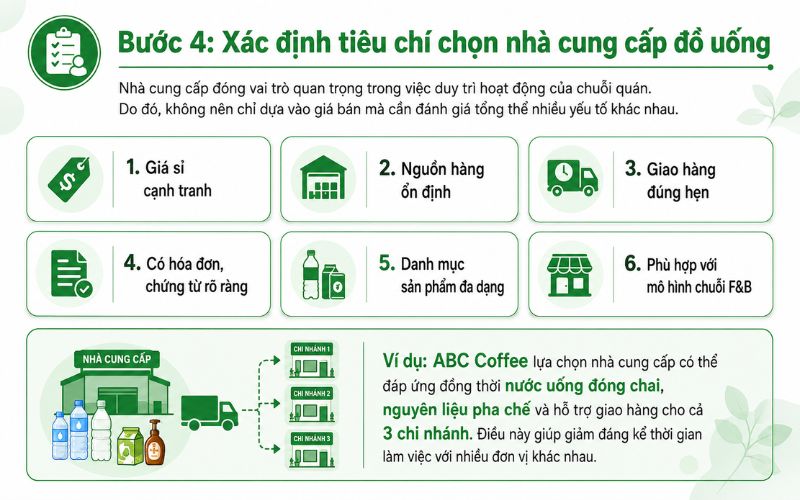
Step 4: Determine the criteria for selecting a beverage supplier.
Suppliers play a crucial role in maintaining the operation of a chain of restaurants. Therefore, one should not rely solely on price but also evaluate many different factors comprehensively.
The criteria that should be prioritized include:
- Competitive wholesale prices
- Stable supply of goods
- On-time delivery
- There are clear invoices and supporting documents.
- Diverse product range
- Suitable for F&B chain models.
For example: ABC Coffee selected a supplier that could simultaneously provide bottled water, beverage ingredients, and delivery support for all three branches. This significantly reduced the time spent working with multiple different suppliers.
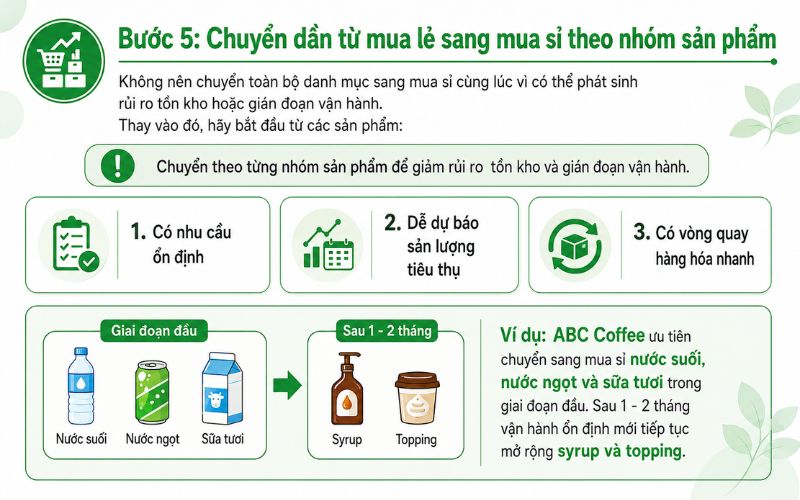
Step 5: Gradually shift from retail to wholesale purchasing by product group.
It is not advisable to switch the entire product catalog to wholesale purchasing at once, as this could lead to inventory risks or operational disruptions.
Instead, let’s start with the products:
- There is a stable demand.
- Consumption volume is easy to predict.
- There is a fast inventory turnover rate.
For example: ABC Coffee prioritize wholesale sourcing of bottled water, soft drinks, and fresh milk in the initial phase. Only after 1-2 months of stable operation will they expand to include syrups and toppings.
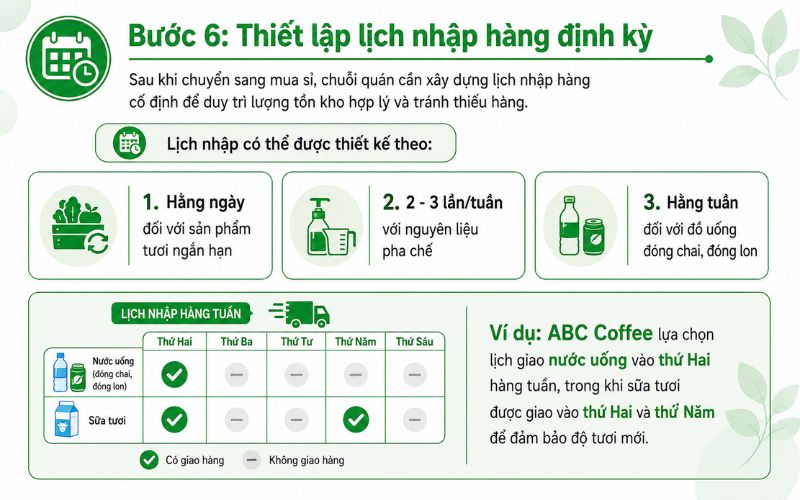
Step 6: Set up a regular delivery schedule.
After switching to wholesale purchasing, the chain needs to establish a fixed restocking schedule to maintain reasonable inventory levels and avoid shortages.
The import schedule can be designed as follows:
- Daily for short-term fresh produce.
- 2-3 times a week with prepared ingredients.
- Weekly for bottled and canned beverages.
For example: ABC Coffee chooses to deliver beverages on Mondays, while fresh milk is delivered on Mondays and Thursdays to ensure freshness.
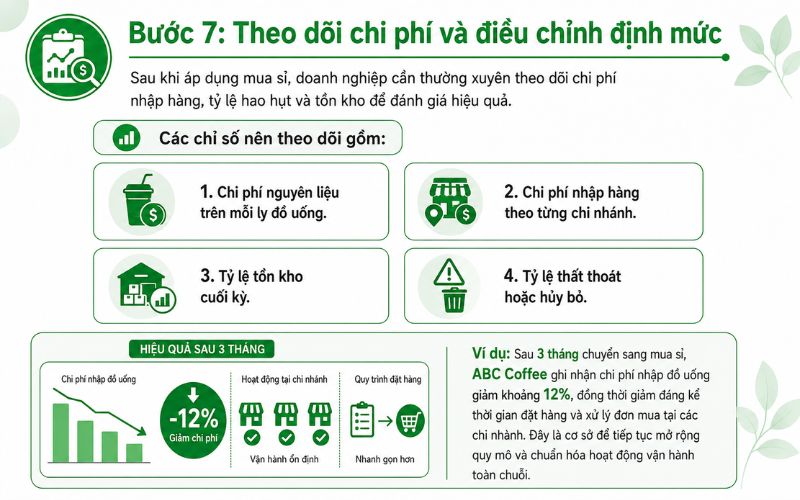
Step 7: Monitor costs and adjust budgets.
After implementing wholesale purchasing, businesses need to regularly monitor purchasing costs, spoilage rates, and inventory levels to assess effectiveness.
The indicators to monitor include:
- The cost of ingredients per drink.
- Cost of goods purchased varies by branch.
- Ending inventory ratio.
- Loss or cancellation rate.
For example:After three months of switching to wholesale purchasing, ABC Coffee recorded a 12% reduction in beverage import costs, while also significantly reducing order placement and processing times at its branches. This provides a foundation for further expansion and standardization of operations across the entire chain.
Checklist for converting retail to wholesale beverage purchases.
To make the transition from retail to wholesale effective, business owners need thorough preparation regarding product catalogs, procurement plans, and inventory management systems. Use the checklist below to assess your business’s readiness before implementation.
Want to quickly assess your shop’s readiness before moving on to wholesale purchasing? Download now! Checklist for converting retail to wholesale beverage purchases for chain stores. To check each important item, minimize inventory risks, and optimize purchasing costs.
Common mistakes when switching to wholesale beverage purchasing.
Switching from retail to wholesale helps restaurant chains optimize costs and supply, but improper implementation can lead to numerous problems with inventory, operations, and cost management. Below are some common mistakes that restaurant owners should avoid.
Choose a supplier based solely on the lowest price.
Many businesses prioritize low prices while overlooking crucial factors such as supply capacity, delivery time, and product quality. In reality, cheap import prices coupled with unstable supply or frequent delivery delays can disrupt business operations, especially during peak hours.
When selecting beverage suppliers, chain stores should evaluate overall criteria such as supply chain stability, product quality, support services, and the ability to meet sudden spikes in demand.
Input too much the first time.
To get the best price, many restaurants tend to order large quantities right from their first wholesale purchase. However, without accurate consumption data, ordering too much can lead to prolonged inventory, expired products, or excessive storage space.
Instead of importing large quantities immediately, businesses should start with a safe level of inventory, monitor actual consumption rates, and then gradually adjust according to the needs of each branch.
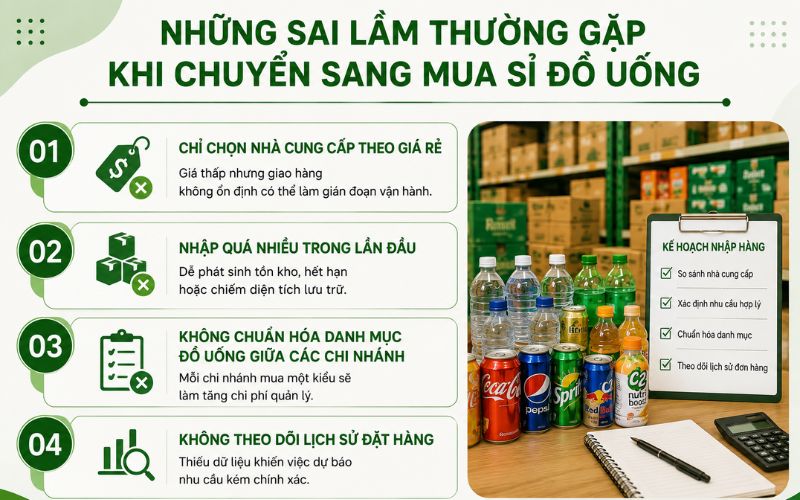
The beverage menu is not standardized across branches.
When each branch uses a different brand or product specification, the business will face difficulties in managing inventory, negotiating prices, and controlling quality.
Standardizing the beverage and ingredient catalog across the entire system helps increase centralized purchasing, optimize procurement costs, and ensure a consistent customer experience at all sales points.
Do not track order history.
Many restaurant chains still manage orders using disjointed ledgers or messages, resulting in scattered and difficult-to-aggregate purchasing data. This reduces accuracy when forecasting demand, developing inventory plans, or evaluating wholesale purchasing efficiency.
Businesses should maintain a centralized order history and regularly analyze consumption data to identify best-selling products, forecast seasonal demand, and optimize inventory levels for each branch.
Kamereo – A comprehensive F&B supplier optimizing procurement processes for restaurant chains.
When transitioning from retail to wholesale beverage sourcing, choosing the right supplier is crucial for ensuring a stable supply, optimizing costs, and reducing operational pressure. Kamereo offers a comprehensive F&B supply chain solution, helping coffee shop chains, bubble tea shops, restaurants, and other beverage businesses manage their procurement operations more efficiently. Kamereo is currently a partner of over 5000 F&B businesses in Vietnam, providing a modern ordering platform and a diverse product ecosystem.
A diverse selection of drinks and ingredients for mixing.
One of the biggest challenges for chain stores is working with numerous different suppliers for each product category. Kamereo simplifies this process by offering a diverse range of products on a single platform, from bottled water, soft drinks, and fruit juices to tea, coffee, milk, syrups, beverage toppings, and many other F&B ingredient groups.
Thanks to its extensive product catalog, restaurant owners can centralize their sourcing through a single supplier, saving management time and optimizing the procurement process for the entire system. Kamereo currently offers over 2,000 products to meet the needs of F&B businesses.
Clear wholesale pricing, suitable for business needs.
Lack of price transparency is one of the issues that makes it difficult for many businesses to control their procurement budgets. With Kamereo, customers can easily track product prices online on the platform and receive regular quotes to proactively plan their expenses.
Making prices public helps chain stores easily compare sourcing costs, forecast budgets, and make more effective purchasing decisions as they expand their businesses.
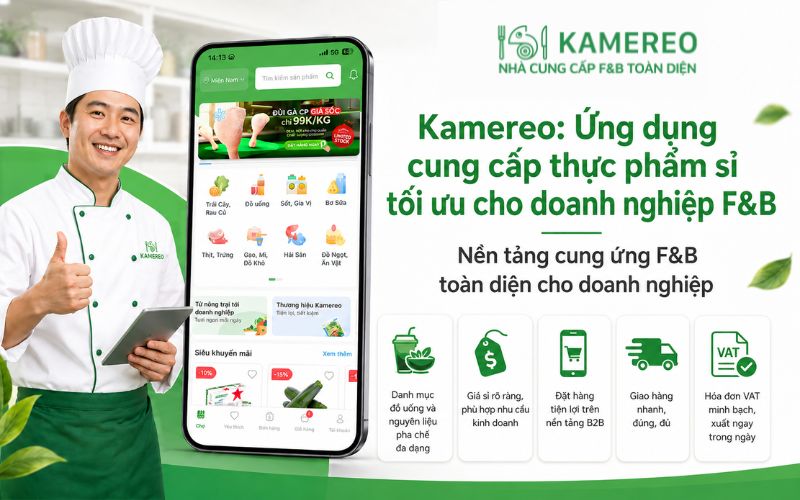
Order conveniently on our B2B platform.
Kamereo applies technology to its procurement operations, allowing businesses to place orders online and manage multiple branches from a single account. Business owners can easily track orders, control costs, view purchase history, and synchronize data between sales points.
This significantly reduces manual processing time, minimizes errors when working with multiple suppliers, and improves the efficiency of chain store management.
Fast, accurate, and complete delivery.
A stable supply of ingredients is crucial for the chain’s continuous operation. Kamereo accepts orders until midnight and delivers from 6 AM the following day, ensuring the business always has a ready supply of ingredients before opening.
In addition, the operating system is optimized to ensure that orders are delivered on time, in full quantity, and with minimal errors, allowing restaurants to confidently serve customers even during peak periods.
Transparent VAT invoices, issued on the same day.
For restaurant chains that require tight financial and documentation management, Kamereo supports VAT invoice issuance for all orders and issues invoices on the same day of delivery.
An online electronic invoicing system allows businesses to easily search, reconcile, and conveniently perform accounting and tax tasks. This is a significant advantage that helps make procurement operations more transparent and professional.
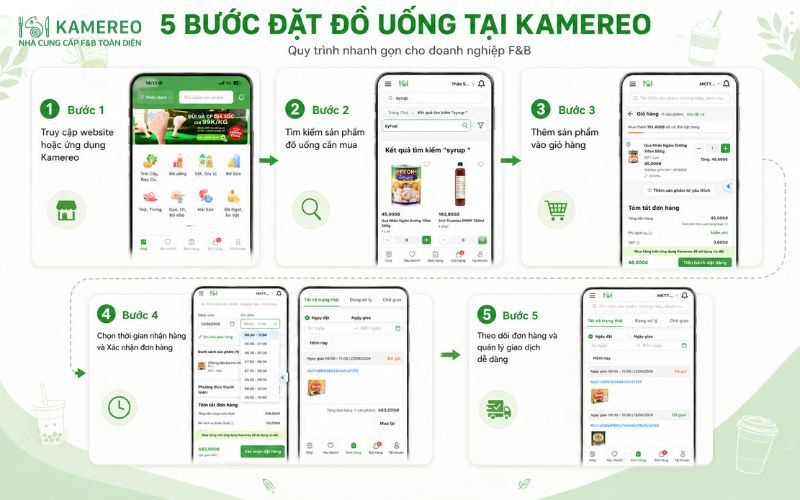
How to order wholesale beverages at Kamereo
Kamereo helps cafes, bubble tea shops, restaurants, and F&B chains simplify their procurement processes through an online ordering platform. With just a few clicks, customers can search for products, place orders, and track the entire delivery process all within a single system.
Step 1: Access the Kamereo website or app.
Customers can log in to the Kamereo website or app using their registered business account. The interface is designed to be intuitive, making it easy for users to manage purchasing activities for one or more branches.
Step 2: Find the beverage you want to buy.
Use the search bar or browse by category to select suitable products such as bottled water, soft drinks, fruit juices, tea, coffee, milk, syrups, and other beverage ingredients.
Product information, prices, and packaging specifications are clearly displayed, making it easy for customers to compare and choose.
Step 3: Add products to your shopping cart.
After selecting the products they want to buy, customers simply enter the desired quantity and add them to their shopping cart. The system will automatically update the total order value for convenient budget management.
Step 4: Choose a delivery time.
Kamereo allows customers to proactively choose delivery times from 6 AM to 6 PM to suit their restaurant’s operating schedule. This helps businesses easily arrange staff for receiving orders and optimize the warehousing process.
Step 5: Confirm the order
Please double-check the product list, quantities, delivery address, and delivery time before confirming your order. After successfully placing your order, you can track its status directly on your account.
Step 6: Track orders and manage transactions easily.
After completing the order, all transaction information and invoices will be stored in the order account on the Kamereo app for customers to conveniently manage and reconcile.
- Orders are accepted until midnight and deliveries begin at 6 AM the following morning.
- Proactively choose a delivery time slot between 6:00 AM and 6:00 PM that suits your operating hours.
- Track your order status in real time directly from your account.
- Check and download electronic VAT invoices directly from the system.
- Easily review your purchase history and reorder old items with just a few taps.
- Manage orders from multiple branches centrally using a single account.
Thanks to its simple, transparent, and flexible online ordering process, Kamereo helps restaurant chains save significant procurement time, reduce manual operations, and ensure a stable supply for their business.
Frequently Asked Questions When Buying Beverages Wholesale for Chain Stores
Should small chain stores buy drinks in bulk?
Yes. Although many suppliers require high MOQs, small-scale businesses can still buy wholesale to optimize costs and ensure a stable supply. With Kamereo, businesses can start ordering from 200,000 VND, making it easy to access wholesale prices without needing to order in large quantities.
Should you buy beverages wholesale on a weekly or monthly basis?
This depends on the consumption rate and storage capacity of the establishment. For most F&B chains, ordering supplies weekly or multiple times a week usually helps to better control inventory and reduce the risk of shortages.
How can I avoid excess inventory when buying wholesale?
Businesses should monitor sales data, forecast actual consumption demand, establish appropriate inventory levels, and choose suppliers with flexible delivery schedules to reduce the amount of inventory held in storage.
What expiration dates should you pay attention to when buying beverages in bulk?
When importing goods in large quantities, it is necessary to carefully check the production date and expiration date, and apply the first-in, first-out (FIFO) principle to minimize losses and ensure product quality.
What types of beverages does Kamereo offer?
Kamereo offers a wide variety of beverages and ingredients for the F&B industry, including bottled water, soft drinks, fruit juices, tea, coffee, milk, cream, syrups, toppings, and many other specialized ingredients, making it easy for businesses to place centralized orders on a single platform.
Summary
Shifting from retail to wholesale beverage sourcing is a crucial step for chain stores to optimize costs, stabilize supply, and improve operational efficiency. With a diverse product portfolio, transparent pricing, a smart ordering platform, and fast delivery services, Kamereo is the ideal solution for F&B businesses looking to professionalize their procurement processes. Contact Kamereo today for advice on wholesale beverage supply solutions tailored to your business needs.