

 0812 46 37 27



You need lettuce for lunch but your supplier only delivers in the morning? Are the Da Lat vegetables delivered too early, leaving insufficient cold storage space? Or is an order coming in the afternoon but you can’t arrange for additional delivery? These are common situations many restaurants encounter during operation.
In fact, the timing of vegetable delivery is just as important as product quality. Choosing the wrong delivery model can lead to ingredient shortages, increased spoilage rates, put pressure on the kitchen staff, and affect customer service quality.
In this article, we will analyze popular wholesale vegetable delivery models, the advantages and disadvantages of each form, evaluation criteria, and how to choose a supplier that suits the operational needs of each restaurant.
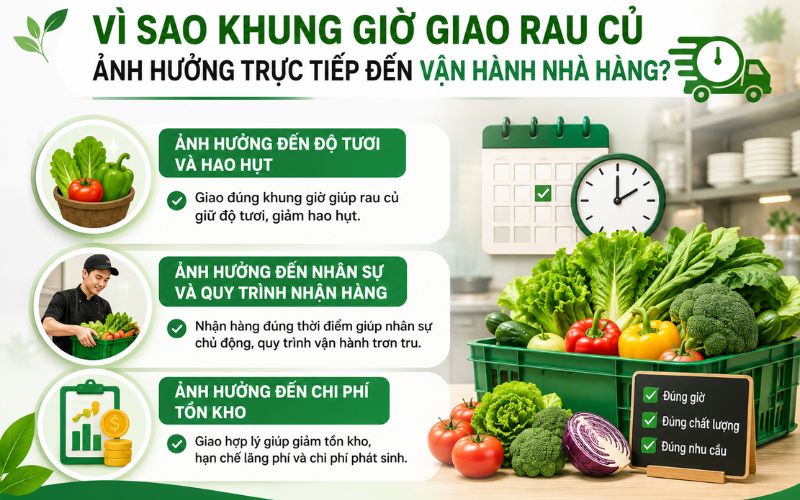
Why does the timing of vegetable delivery directly affect restaurant operations?
For restaurants, vegetables are a group of ingredients used daily with high frequency and require strict freshness standards. Therefore, delivery times not only affect ingredient quality but also directly impact operational processes, staff efficiency, and inventory management costs. A suitable delivery schedule helps the kitchen proactively prepare ingredients, optimize resources, and maintain customer service quality.
Affects freshness and spoilage.
If vegetables are delivered too early, they may need to be stored for a long time before use. Under improper storage conditions, vegetables can easily wilt, lose freshness, or deteriorate in quality, especially delicate items like leafy greens, herbs, salad greens, and mushrooms.
Conversely, when deliveries are too late, the kitchen staff may not have enough time to inspect, pre-process, and prepare ingredients for scheduled serving times. This increases the risk of temporary ingredient shortages or impacts the speed of food service during peak hours.
Impact on staffing and receiving processes.
Delivery times need to be synchronized with the work schedules of the kitchen staff and receiving personnel. If the delivery vehicle arrives during peak hours or while the kitchen is busy serving customers, staff will have to temporarily stop working to count and receive the goods, disrupting the operational process.
Furthermore, the lack of a designated person to receive the goods on time can easily lead to errors in counting the quantity, quality, or type of products. Therefore, many restaurants often prioritize choosing suppliers with delivery schedules that align with their ingredient prep times and the work schedules of their responsible staff.
Impact on inventory costs
Delivery frequency is closely related to inventory costs. If suppliers deliver large quantities or deliver too early compared to demand, restaurants will have to stock more ingredients, increasing storage costs and the risk of spoilage.
Conversely, delivering too little or failing to meet demand can force restaurants to place multiple reorders, increasing shipping costs and order management work load. Therefore, an ideal delivery schedule needs to balance ingredient freshness, shelf life, and cost-effectiveness in daily operations.
Evaluating popular wholesale vegetable delivery models for restaurants.
Each restaurant has different sizes, customer volumes, and ingredient needs, so there is no single delivery model that suits every case. Some establishments prioritize fixed delivery schedules for easier operational control, while restaurants with fluctuating needs require flexible delivery options. Additionally, large chains may implement consignment or inventory replenishment models to ensure a continuous supply.
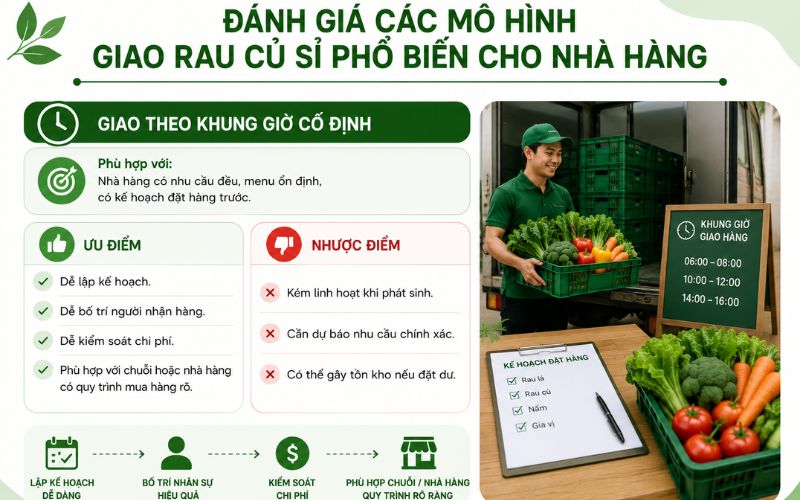
Delivery within a fixed timeframe.
This is a model where the supplier delivers at pre-agreed times, such as early morning or late evening each day. This format is suitable for restaurants with a stable customer base, infrequent menu changes, andThere are plans to place an order in advance.
Advantage:
- It’s easy to plan orders and prepare ingredients.
- It’s easy to arrange personnel for receiving and counting goods.
- This facilitates the control of purchasing costs.
- Suitable for restaurant chains or models with clear procurement processes.
Disadvantages:
- It is difficult to meet unexpected demands.
- The requirement is for relatively accurate demand forecasting.
- Overordering can increase inventory and lead to losses.
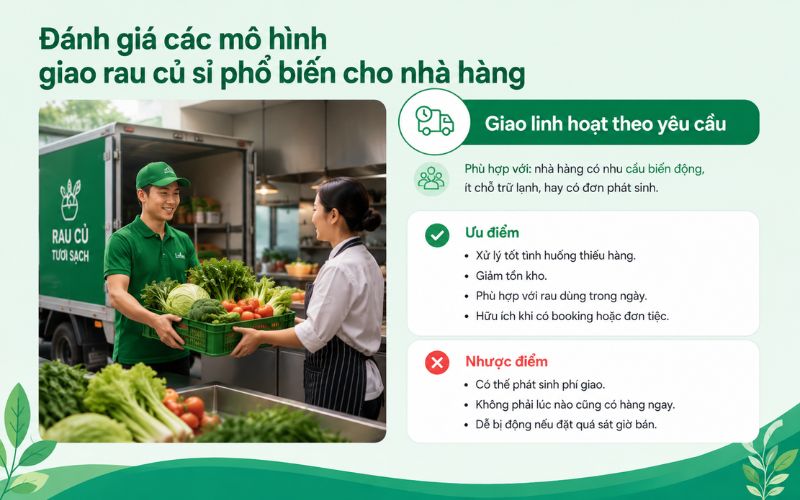
Flexible delivery options available upon request.
With this model, restaurants can place orders as needed and request delivery within a short timeframe. This is a suitable option for restaurants with fluctuating customer volumes, limited storage space, or those that frequently receive large orders for parties, events, and bookings.
Advantage:
- Promptly address situations involving product shortages.
- Reduce inventory levels and the risk of losses.
- Suitable for vegetables used on the same day.
- Useful when there are unexpected table reservations or party requests.
Disadvantages:
- Additional delivery charges may apply.
- Items are not always available for immediate delivery.
- It’s easy to be caught off guard if you book too close to the serving time.
Delivery on a consignment basis or stock replenishment as agreed.
This model involves a supplier and restaurant agreeing to maintain a certain inventory level. The supplier will proactively replenish stock when inventory levels fall below the agreed threshold. This format is typically suitable for restaurant chains, central kitchens, or units with stable sales volumes.
Advantage:
- Reduce the risk of raw material shortages.
- Suitable for groups of vegetables that are used frequently.
- This helps maintain a stable supply in the long term.
Disadvantages:
- A strict inventory management process is needed.
- It is necessary to clearly define responsibilities regarding losses, damage, and returns.
Should restaurants choose fixed delivery rates or flexible delivery options?
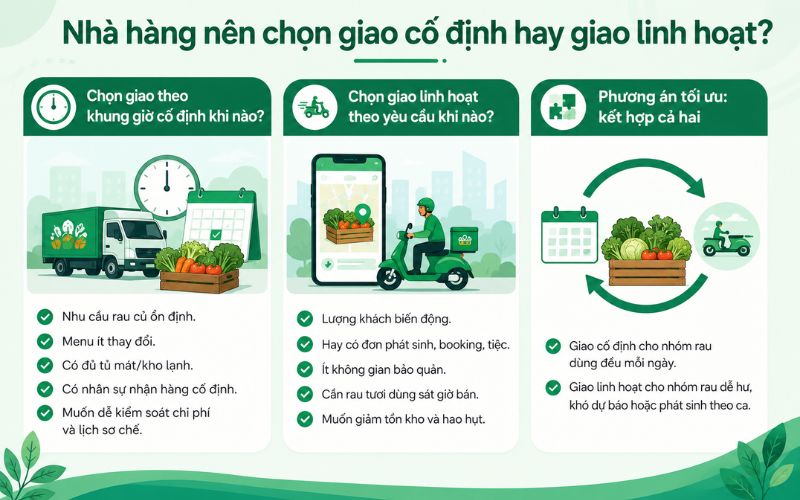
No single delivery model is suitable for every restaurant. The optimal choice depends on customer volume, menu consistency, ingredient storage capabilities, and the operational organization of each establishment. Identifying the right delivery model will help restaurants maintain a stable supply, minimize waste, and optimize inventory costs.
When can I choose delivery at fixed times?
Scheduled deliveries are a suitable option for restaurants with relatively stable operational processes and good forecasting of ingredient needs.
This model should be preferred when:
- The demand for vegetables remains stable: Suitable for restaurants with consistent daily or weekly usage.
- The menu rarely changes: It’s easy to predict the quantity of raw materials that need to be imported.
- Do you have a cold storage or refrigerator? Ensure proper storage of goods.
- There are fixed personnel for receiving goods: Convenient for counting and receiving.
- To maintain tight operational control: It’s easy to manage costs, preparation schedules, and inventory plans.
When should you choose flexible delivery options?
Flexible delivery is suitable for restaurants that need to be able to respond quickly to changes in customer numbers or ingredient needs.
Restaurants should consider this model when:
- The number of visitors fluctuates: Suitable when needs change daily or hourly.
- Unexpected orders arise: Useful when you frequently have bookings, parties, or urgent orders.
- Limited cold storage capacity: Suitable for restaurants with limited storage space.
- We need very fresh vegetables: It’s best to order ingredients close to the time of use to maintain their quality.
- Want to reduce inventory? Helps to reduce excess inventory and minimize material waste.
The optimal solution: a combination of both.
In fact, many restaurants don’t opt for a single model but combine both fixed and flexible delivery to balance stability with the ability to meet evolving demand.
A common implementation is to use a fixed delivery schedule for groups of vegetables that are consumed regularly each day, such as kale, cabbage, carrots, or onions. Meanwhile, leafy vegetables, herbs, salads, or items with unpredictable demand can be added through flexible delivery as needed.
This combination helps the restaurant maintain a stable supply for daily operations, while reducing inventory risks and preventing shortages of ingredients when customer numbers surge.
Quick comparison table of wholesale vegetable delivery models
When choosing a wholesale vegetable supplier, many restaurant owners wonder whether to prioritize fixed-time delivery, flexible delivery based on demand, or a consignment model. Each method has its own advantages and suits different operational needs. The table below will help you quickly compare the most popular wholesale vegetable delivery models currently available.
|
Criteria |
Fixed delivery |
Flexible delivery |
Consignment/Replenishment of Inventory |
|
Suitable for stable needs |
Very suitable |
Medium |
Very suitable |
|
Processing incoming orders |
Medium |
Good |
It’s good if there’s an agreement. |
|
Cost control |
Good |
Medium |
Medium |
|
Reduce inventory |
Medium |
Good |
Careful management is needed. |
|
Kitchen autonomy |
High if the forecast is good. |
High when it occurs |
High in value for frequently used items. |
|
Main risks |
Surplus or shortage of goods due to inaccurate forecasts. |
Delivery was delayed or the item was out of stock. |
Difficult to control losses. |
|
Best suited for |
Stable restaurant, restaurant chain |
Restaurants have fluctuating demand and limited cold storage space. |
Central kitchen, large chain, high output |
Fixed-time delivery is suitable for restaurants with stable demand and a desire for tight cost control. Mean while, flexible delivery on demand helps handle unforeseen situations and reduce inventory levels. For restaurant chains or central kitchens with high production volumes, consignment or inventory replenishment models can be effective solutions for maintaining a stable supply.
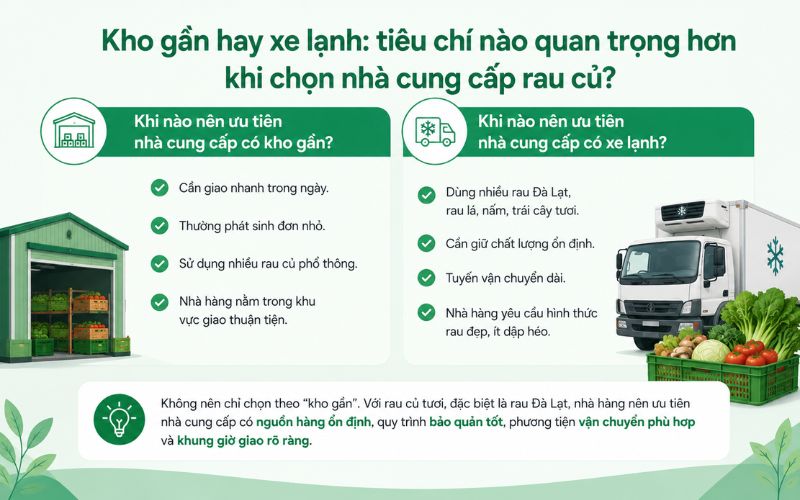
Nearby warehouse or refrigerated truck: which criterion is more important when choosing a vegetable supplier?
When evaluating wholesale vegetable suppliers, many restaurants often prioritize those with nearby warehouses to shorten delivery times. However, geographical distance is not the only factor determining the quality of vegetables when they reach the kitchen. Logistics capabilities, including storage systems, transportation vehicles, and the ability to deliver on time, also play a crucial role in maintaining the freshness of ingredients.
In reality, whether to prioritize a nearby warehouse or a refrigerated truck depends on the characteristics of the ingredients, operational needs, and quality requirements of each restaurant.
When should you prioritize a supplier with a nearby warehouse?
Suppliers who have warehouses or distribution centers near the business area often offer advantages in terms of delivery speed and the ability to handle incoming orders.
This model is suitable when:
- Need same-day delivery: Suitable for restaurants that need to restock ingredients quickly.
- Small orders are placed frequently: Provides good support for additional purchases beyond the planned budget.
- Common vegetables: Suitable for product categories that are less sensitive to shipping time.
- Convenient transportation area: This helps to ensure faster and more reliable delivery.
In these cases, shorter distances help reduce waiting times, increase responsiveness during unexpected shortages, and support more flexible operations.
When should you prioritize a supplier with refrigerated vehicles?
For restaurants that require high-quality ingredients, a cold chain transportation system is often more important than the location of the warehouse.
Restaurants should prioritize suppliers with refrigerated trucks when:
- Use plenty of Da Lat vegetables, leafy greens, herbs, mushrooms, or fresh fruit: Transportation requires appropriate conditions to maintain freshness and minimize spoilage.
- Maintaining consistent raw material quality throughout the year is essential: Priority will be given to units with stable storage and delivery procedures.
- The shipping route is long or passes through multiple areas: Refrigerated vehicles help reduce the impact of temperature and travel time.
- The requirement is that vegetables should be in good condition and not be bruised or damaged: Suitable for restaurants that prioritize presentation quality and freshness when serving dishes.
Refrigerated transport systems help maintain the appropriate temperature throughout the transportation process, thereby reducing spoilage and extending the freshness of ingredients before they reach the restaurant. Don’t just choose based on proximity to the warehouse. For fresh vegetables, especially those from Da Lat, restaurants should prioritize suppliers with a stable supply, good preservation processes, suitable transportation methods, and clear delivery schedules.
Suggested options based on specific restaurant operating scenarios.
Each restaurant has different operating characteristics, ingredient needs, and storage capabilities. Therefore, choosing a wholesale vegetable delivery model should be based on the actual situation rather than applying a fixed plan to all cases. The table below will help restaurant owners determine the delivery model that best suits their operational needs.
|
The restaurant’s situation |
Which model should I choose? |
Reason |
|
Fixed menu, steady stream of customers. |
Fixed delivery |
It is easy to forecast raw material demand, which facilitates cost and inventory control. |
|
There are often additional bookings or party orders arising. |
Fixed delivery + flexible delivery |
This ensures both a steady supply of goods for daily operations and the ability to handle sudden spikes in demand. |
|
Limited cold storage space |
Flexible delivery or divided delivery timeframes |
Reduce inventory levels, minimize losses, and lessen storage pressure. |
|
Use plenty of salad greens, herbs, and mushrooms. |
Delivery near the scheduled time, combined with refrigerated vehicle service. |
It helps maintain freshness, minimize wilting, and keep the quality of ingredients stable. |
|
The restaurant has multiple branches. |
Fixed delivery combined with a clear ordering system. |
It’s easy to standardize the process of receiving goods, reconciling and managing costs across sales points. |
|
The kitchen often runs out of vegetables between serving shifts. |
There is an option for additional deliveries during the day. |
Reduce the risk of running out of ingredients and minimize the impact on the menu served to customers. |
|
To optimize purchasing costs. |
Fixed delivery and order consolidation |
Reduce the number of small deliveries, optimizing shipping and operating costs. |
Instead of focusing solely on factors like price or delivery distance, restaurants should choose a model that suits their actual operational needs. A combination of a well-planned delivery schedule, the ability to handle incoming orders, and the supplier’s logistics capabilities will help maintain a stable supply, reduce losses, and improve long-term business efficiency.
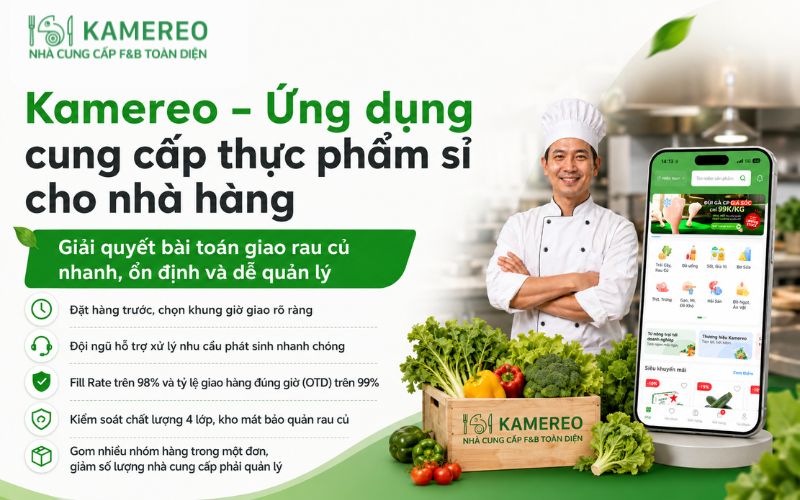
How does Kamereo help restaurants solve the problem of wholesale vegetable and fruit delivery?
For restaurants, choosing a wholesale vegetable supplier involves more than just product quality; it also relates to on-time delivery, meeting evolving needs, and supporting efficient procurement management. With its specialized wholesale food supply solution for the F&B industry, Kamereo helps restaurants be more proactive in sourcing, reducing operational pressure and maintaining a stable daily supply.
Place your order in advance and choose a specific delivery time.
Kamereo allows restaurants to place orders until midnight and proactively choose delivery times from 6:00 AM to 6:00 PM depending on operational needs. This enables kitchens to flexibly schedule deliveries to fit their ingredient prep schedules, staff shifts, and customer service times.
In addition, the entire ordering process, tracking delivery status, and order history are managed on a single platform. This helps restaurants easily plan their inventory, minimize operational errors, and save time when working with suppliers.
Team Support for quickly addressing emerging needs.
Kamereo has a dedicated and enthusiastic customer support team that helps restaurants handle any issues related to orders, deliveries, and sourcing during daily operations. When needing to replenish supplies, change orders, or require urgent assistance, restaurants can contact them directly for prompt support.
On-time delivery capability
One of the key factors when choosing a wholesale vegetable supplier is their ability to deliver on time and ensure sufficient quantities of goods.
Kamereo currently maintains a Fill Rate of over 98% and an On-Time Delivery (OTD) rate of over 99%, helping restaurants reduce the risk of ingredient shortages or operational disruptions due to delayed deliveries. In addition, the system supports orders placed until midnight and deliveries starting early the next morning, ensuring the kitchen always has ingredients ready for the next day.
Four-tiered quality control, cold storage for vegetables.
For fresh vegetables, especially those from Da Lat, leafy greens, mushrooms, and fruits, product quality depends heavily on the supply chain and preservation processes.
Kamereo possesses a supply chain advantage, encompassing a network of partner farms, procurement centers, distribution warehouses, and final delivery.The product undergoes quality control through four layers: (1) farm/supplier inspection, (2) warehouse inspection, (3) cold storage inspection, and (4) pre-shipment inspection.
Combined with a cold storage system and a supply chain from partner farms to restaurants, Kamereo helps maintain consistent freshness and quality for Da Lat vegetables, leafy greens, herbs, mushrooms, and fruits..
Consolidate multiple product categories into a single order, reducing the number of suppliers to manage.
Kamereo offers over 2,000+ products across various categories, from fruits and vegetables, fresh produce, and frozen foods to beverage ingredients and kitchenware. This allows restaurants to consolidate multiple items into a single order, reducing the number of suppliers to manage and simplifying the procurement process.
If your restaurant is looking for a stable wholesale source of vegetables, with the ability to choose convenient delivery times and easily manage orders on a single platform, Kamereo is a worthwhile solution to optimize your daily sourcing and kitchen operations.
Frequently Asked Questions
Should small restaurants choose fixed or flexible delivery options?
If the demand for vegetables is relatively stable each day, small restaurants can prioritize deliveries at fixed times to easily control costs and inventory planning. Conversely, if customer numbers fluctuate frequently or there is limited storage space, flexible delivery options should be incorporated to reduce inventory and minimize spoilage.
Should you prioritize storing vegetables from Da Lat in a nearby warehouse or using a refrigerated truck?
A nearby warehouse helps shorten delivery times, but for Da Lat vegetables and other fresh produce, a refrigerated transport system and preservation process are often more important. A supplier with a good preservation chain will help maintain consistent vegetable quality throughout the transportation process.
Should we import vegetables multiple times a day?
Receiving multiple vegetable deliveries throughout the day may be suitable for restaurants that use a lot of fresh produce or have limited storage space. However, if the frequency of deliveries increases transportation costs or disrupts the receiving process, the restaurant should consider optimizing the number of deliveries to suit its actual needs.
Conclude
No single wholesale vegetable delivery model is suitable for every restaurant. Fixed delivery is an effective option for establishments with stable needs and a desire to control costs, while flexible delivery is suitable for restaurants with fluctuating customer volumes or frequent unexpected demands. In fact, combining both models often yields more optimal operational efficiency. Most importantly, restaurants should choose a supplier with a stable supply, on-time delivery, good storage practices, and a clear process for handling any issues to ensure ingredient quality and maintain business continuity.