

 0812 46 37 27



When importing food wholesale, F&B businesses need to pay attention not only to price but also to payment methods and terms to ensure a stable cash flow. Choosing a payment method that suits the order size helps businesses proactively control costs, reduce short-term financial pressure, and minimize risks arising from partnerships with suppliers. This is also a crucial factor in maintaining a stable supply and operating more efficiently.
Why is payment method important when importing food wholesale?
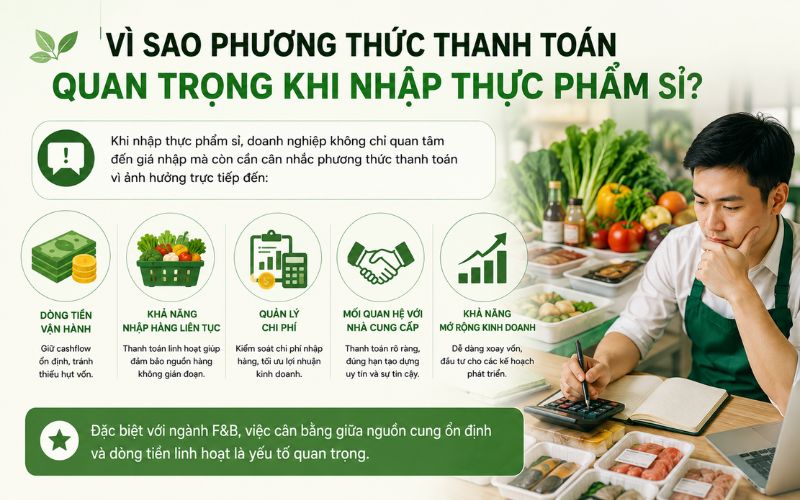
When importing food in bulk, restaurant owners, eateries, or F&B businesses must not only consider the import price but also calculate the payment methods and terms. If the payment terms do not match the actual cash flow, the business may face capital pressure, struggle to maintain the necessary inventory levels, or incur unexpected costs.
A well-established payment method will directly impact:
- Operating cash flow: Proactively balance capital for inventory, personnel, premises, and other fixed costs.
- Ability to receive goods continuously: Ensure you have sufficient supplies to support your business operations, especially for restaurants that require regular deliveries.
- Cost management: It’s easy to track accounts payable, payment deadlines, and total purchase costs for each period.
- Relationship with suppliers: Timely and transparent payments help build a good business history and lay the foundation for long-term cooperation.
- Business scalability: When cash flow is well managed, businesses have more room to increase order sizes, open more outlets, or invest in business operations.
In particular, the F&B industry is characterized by a rapid raw material turnover, high frequency of inventory purchases, and cash flow that fluctuates with revenue. Therefore, balancing a stable supply with flexible payment capabilities is crucial for businesses to maintain continuous operation while effectively managing financial pressure.
Common payment methods when importing food in bulk.
Depending on the scale of business, frequency of orders, and ability to balance cash flow, F&B businesses can choose from many options. There are various payment methods when buying food wholesale. Basically, common methods include upfront payment, cash on delivery, installment payments/credit, and periodic contract payments. Each method has its own advantages, limitations, and suitability for different business models.
1. Prepayment
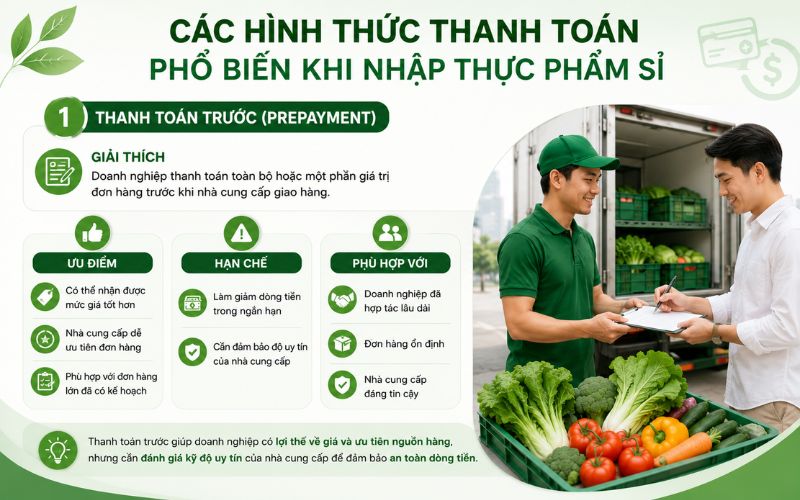
This is a business model where the full or partial value of an order is paid before the supplier delivers the goods. This method is usually suitable for orders with clear plans or when the business has built a certain level of trust with the supplier.
Advantage:
- Better prices or purchasing terms may be available depending on the agreement.
- The supplier has grounds to prioritize the preparation and delivery of the order.
- Suitable for large orders, with pre-planned production volumes.
Limit:
- It reduces the amount of cash a business can use in the short term.
- Businesses need to carefully assess the reputation and ability of their suppliers to fulfill orders.
Suitable for: New F&B businesses partnering with suppliers, placing large orders, or needing to place orders in advance.
2. Cash on Delivery (COD)
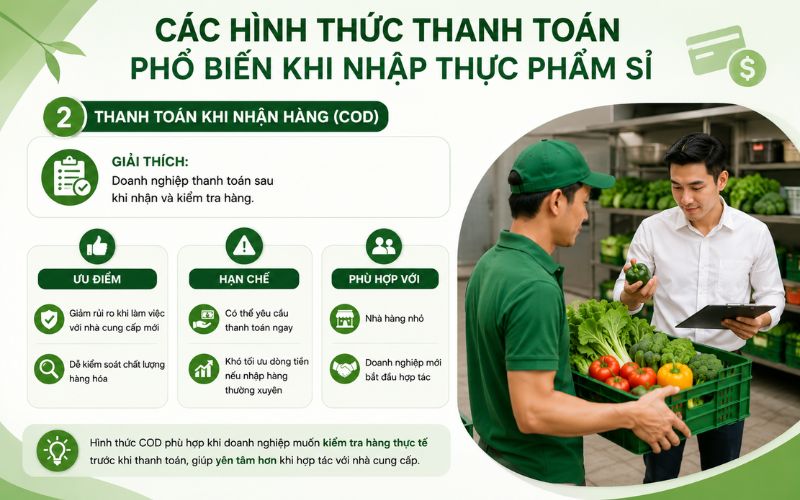
With COD (Cash on Delivery), businesses pay after receiving and inspecting the goods. This method allows customers to pay the full order value in cash or by bank transfer as instructed by the supplier.
Advantage:
- Reduce risk when starting a partnership with a supplier.
- Businesses can receive and inspect the goods before making payment.
- Suitable for orders requiring payment upon delivery.
Limit:
- Businesses still need to have sufficient budget available at the time of receiving the goods.
- If you import goods frequently, paying for each order individually can put pressure on your cash flow.
Suitable for: Restaurants, small eateries, and new businesses that want to inspect goods before payment or have no prior transaction history with a supplier.
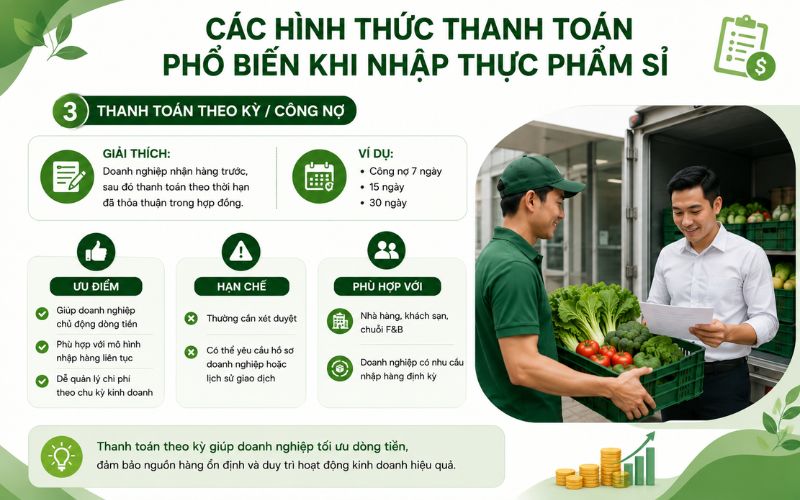
3. Payment by installments / accounts receivable
This is a business model where businesses receive goods first and pay later according to an agreed-upon payment schedule with the supplier. The payment term is predetermined, which may be based on the contract, sales agreement, or policy applied to each customer group.
Common payment terms can be 7 days, 15 days, or 30 days. Businesses need to complete payment within the agreed timeframe to ensure their rights and maintain the terms of purchase.
Advantage:
- This helps businesses manage their cash flow proactively instead of having to pay for each order immediately.
- Suitable for restaurants, hotels, and F&B chains that require a continuous supply of ingredients.
- It’s easy to reconcile and manage expenses for each payment cycle.
- Facilitating businesses in balancing revenue and payment schedules.
Limit:
- Not all customers are eligible. Businesses need to meet certain conditions and be approved.
- Relevant business documents, sales contracts/agreements, and transaction history may be required.
- The terms regarding reconciliation, documentation, payment schedules, and handling of overdue payments are implemented according to the signed agreement.
Suitable for: Restaurants, hotels, F&B chains, and businesses have established stable partnerships, a good payment history, and regular ordering needs.
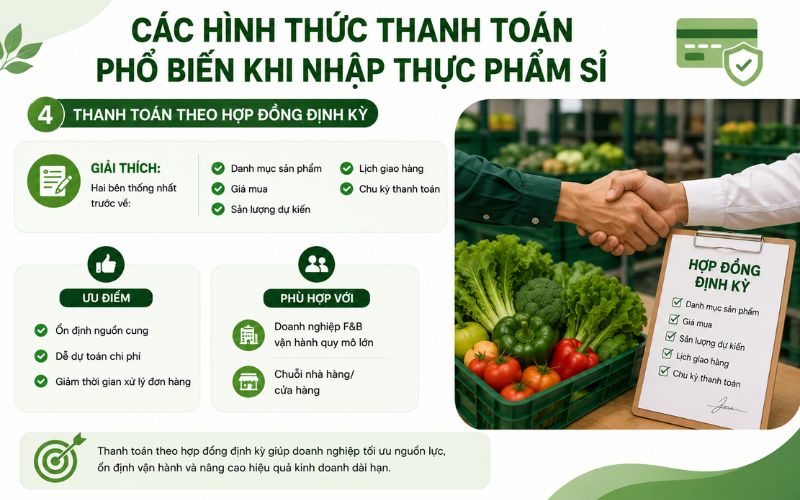
4. Payment according to the contract schedule.
In this model, businesses and suppliers agree in advance on purchasing terms in a contract or agreement, such as product catalog, purchase price, expected output, delivery schedule, and payment cycle. This approach is suitable for businesses that need to import raw materials regularly and want to proactively plan their supply chain.
Advantage:
- It helps businesses proactively plan their supply chains.
- Easy to estimate budget and material costs.
- Reduce the time spent renegotiating terms and conditions for each order.
- Establish a clear basis for both parties to reconcile and settle outstanding debts.
Limit:
- Businesses may be required to commit to purchasing goods or making payments on a schedule, even though actual demand may change.
- Reduced cash flow flexibility, as it requires securing budgets for recurring payments.
- It is necessary to closely monitor the contract terms and conditions to avoid incurring additional fees or breaches of commitment.
Suitable for: Large-scale F&B businesses, restaurant chains, retail chains, or entities requiring stable, long-term purchasing needs.
What payment method should businesses choose when importing food in bulk?
Not all F&B businesses are suited to the same payment method. To make the right choice, businesses should consider several factors. Supplier reliability, order frequency, order size, number of branches, and cash flow management capabilities. You can refer to the selection methods below:
|
Business needs |
Appropriate method |
Reason |
|
New to working with this supplier. |
Cash on Delivery (COD) or Payment per order. |
Reduce risk levels and facilitate quality control of the delivery process before transitioning to a longer-term credit arrangement. |
|
Want to control cash flow? |
Accounts payable by period |
This helps F&B businesses retain cash for longer periods, allowing them to proactively utilize cash flow for operations before payment deadlines to suppliers. |
|
Regularly import goods or have multiple branches |
Periodic Contracts or Accounts Receivable on a Periodic Basis |
Control inventory, costs, and payment obligations on a periodic basis instead of processing each order individually. |
|
To optimize import costs. |
Production agreement + suitable payment method |
This creates a basis for negotiating better import prices, while also optimizing purchasing costs through economies of scale. |
Key principle: There is no single best payment method for every business. Choose the one that suits you best. It depends on the scale of imports, frequency of purchases, stability of supply, and ability to manage cash flow. For F&B businesses, a good payment method is one that ensures a continuous supply of goods while not putting excessive pressure on operating cash flow.
Conditions for businesses to be granted credit terms when importing food in bulk.
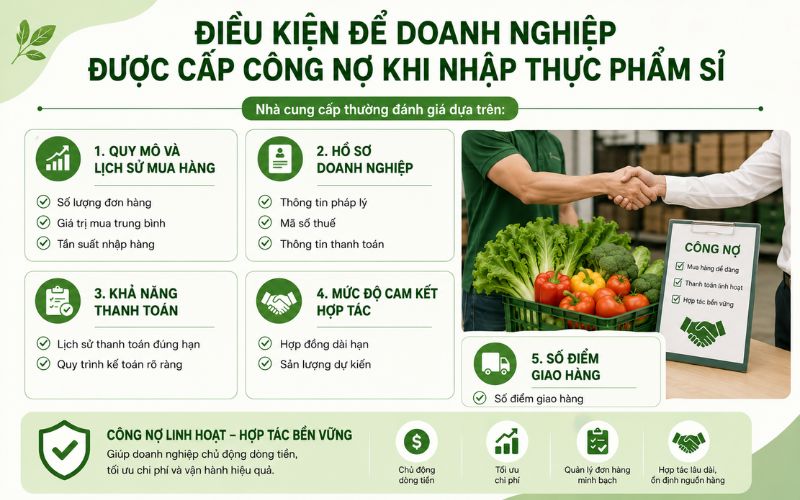
Not all businesses are eligible for credit terms right from the start. Suppliers typically need to assess the scale of operations, transaction history, and payment ability before deciding on credit limits and terms. For F&B businesses, factors considered for credit terms usually include:
- Scale and purchase history: Average purchase value, order quantity, and order frequency help suppliers assess actual demand and the stability of the business.
- Company profile: Legal information, tax identification number, and other relevant information must be provided in full to facilitate the review process.
- Ability to pay: Suppliers can review a company’s payment history, ability to pay on time, and accounting processes to assess debt risk.
- Level of commitment to cooperation: Long-term contracts, projected production volumes, and the number of delivery points can serve as a basis for both parties to determine purchasing needs and appropriate credit terms.
Therefore, businesses needing to import food in bulk on credit should prepare complete documentation, transaction information, and clearly discuss quantity, limits, and payment terms from the outset of establishing a partnership. Specific conditions will depend on the approval policy and agreement between the business and the supplier.
Factors to consider before choosing a wholesale food supplier.
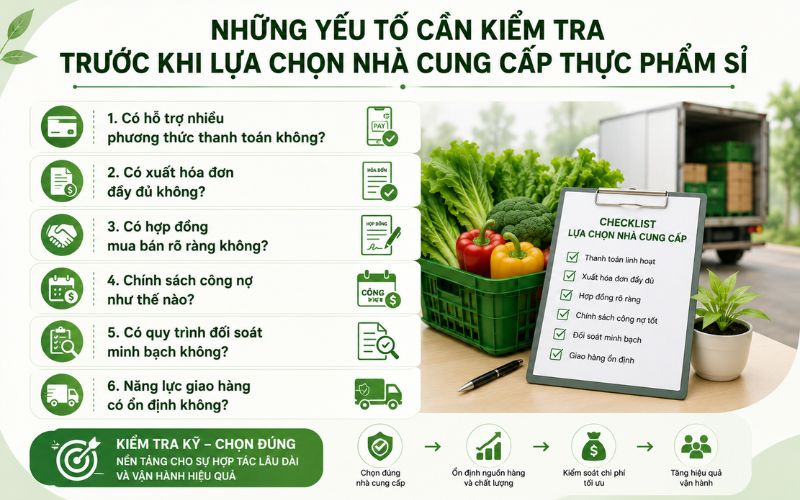
The purchase price is only one part of the equation when choosing a wholesale food supplier. For F&B businesses, a suitable supplier also needs to meet requirements regarding payment, documentation, accounts receivable, reconciliation, and delivery capacity to ensure a stable procurement process and minimize operational issues. Before signing a contract or increasing purchase volume, businesses should check:
- Do you support multiple payment methods? Determine what payment options the supplier offers, such as cash on delivery, bank transfer, or deferred payment on credit.
- Will a full invoice be provided? Verify the ability to provide invoices and supporting documents that meet the accounting and cost management needs of the business.
- Is there a clear sales contract? Details regarding price, products, delivery, payment, and the responsibilities of both parties should be clearly defined.
- What is the debt policy? The conditions for approval, credit limits, terms, and procedures for handling outstanding debts need to be clarified.
- Is there a transparent reconciliation process? Businesses should check how suppliers record payments, reconcile orders, and handle cases of incorrect payments or necessary adjustments.
- Is the delivery capacity stable? Assess the company’s ability to meet production demands, delivery times, and stability as the frequency or scale of orders increases.
Checking these factors helps businesses evaluate suppliers based on total costs and operational efficiency, rather than just comparing prices. Especially for restaurants and F&B chains with frequent inventory needs, a supplier with clear payment policies, transparent accounts receivable and reconciliation mechanisms will significantly reduce the pressure of managing cash flow.
What payment methods does Kamereo support for F&B businesses when importing food in bulk?
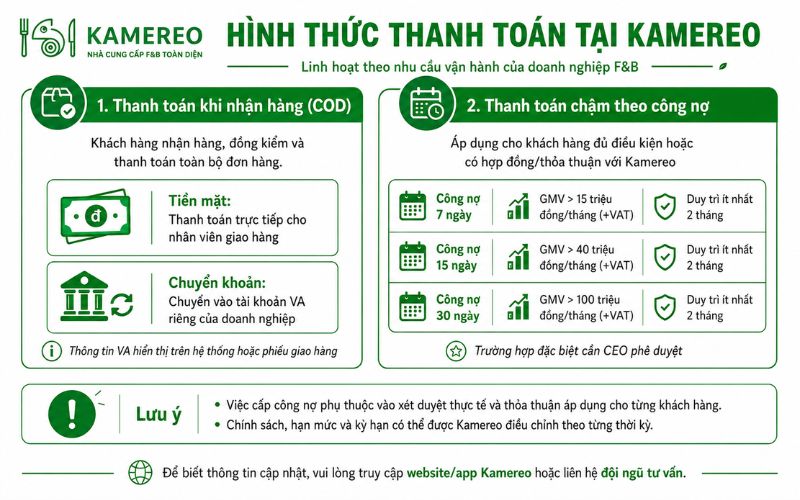
For F&B businesses that frequently need to import wholesale food, Kamereo supports payment methods tailored to their operational needs, including cash on delivery (COD) and deferred payment based on approved credit terms.
Payment upon delivery
With the Cash on Delivery (COD) method, customers receive and inspect the goods before paying the full order value. Kamereo supports two payment methods:
- Cash: Pay the delivery person directly upon handover.
- Transfer: Transfer the payment to the company’s private VA (Virtual Account). The VA account information is displayed on the Kamereo system or printed on the delivery slip for convenient reconciliation.
Late payment due to outstanding debt
For businesses requiring regular inventory, Kamereo offers deferred payment options based on approved credit terms. Current policy stipulates a maximum credit term of 30 days, or as otherwise agreed upon in the contract. This option applies to customers who meet the conditions and/or have a contract or sales agreement with Kamereo, including credit limits and terms.
According to Kamereo’s debt policy, the established terms include:
- 7-day payment terms: Applicable to customers who have Monthly GMV > 15 million VND (+VAT) And this GMV level needs to be maintained for at least two months. Exceptional cases require CEO approval.
- 15-day payment terms: Applicable to customers who have Monthly GMV > 40 million VND (+VAT)And this GMV level needs to be maintained for at least two months. Exceptional cases require CEO approval.
- 30-day payment terms: Applicable to customers who have Monthly GMV > 100 million VND (+VAT)And this GMV level needs to be maintained for at least two months. Exceptional cases require CEO approval.
The actual granting of credit still depends on the approval criteria and the agreement/contract applicable to each customer.
Note: Payment policies and terms, credit limits, and applicable terms may be adjusted by Kamereo from time to time. Businesses should access the Kamereo website/app or contact the consulting team to receive the most accurate and up-to-date information at the time of registration.
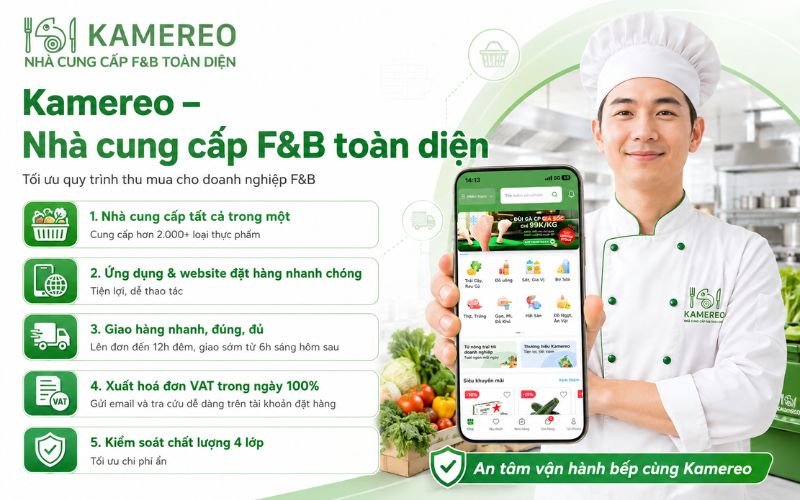
Kamereo – A comprehensive F&B supplier optimizing procurement processes for F&B businesses.
In the operation of restaurants, cafes, hotels, or F&B chains, businesses often have to work with many suppliers for different product categories. This makes sourcing ingredients, comparing prices, tracking orders, and controlling costs complicated. Kamereo develops according to this model.”All-in-one supplier “This helps businesses consolidate their procurement needs on a single platform, from fresh and frozen foods to beverage ingredients and kitchenware.
- Diverse product range to meet F&B needs: Kamereo provide more 3,000 products – This makes it easier for businesses to find ingredients, compare prices, and place orders on a single platform. The concentration of multiple product groups is also a key benefit. This product helps reduce the time spent searching for and managing multiple individual suppliers.
- Applying technology in procurement management: Kamereo – It not only supports ordering but also provides features for operational management such as Manage multiple branches on the same account, approve orders, track order history, generate reports, and analyze expenses. Businesses can track orders by branch and control inventory levels.Collect and analyze costs by item, supplier, or time period.
- Transparent pricing helps with budget control: Instead of contacting each supplier individually to inquire about prices, businesses can update product prices online. Kamereo app and website – Kamereo also proactively sends monthly price quotes, helping businesses track price fluctuations and be more proactive in planning their procurement budgets.
- Fast and reliable delivery: Kamereo supports businesses The order has arrived.12 AM and delivery before 6 AM the next day. This ensures the kitchen has ingredients ready when it starts operating. According to the document, Kamereo achieved…99%+ of orders are delivered on time, 98%+ of items are shipped complete, and 99.5%+ of products are defect-free..
- Quality control from input to delivery: Kamereo applies a multi-step quality control process, from farm to farm. The products are transported from the Duc Trong purchasing center to the distribution center in Ho Chi Minh City. The products are further inspected before delivery to businesses. The warehouse system has specialized cold and freezer rooms and applies specific principles. FIFO (First In – First Out)in inventory management.
- Complete VAT invoices, convenient for reconciliation: The Mereo provides VAT invoice for 100% of the order .We issue invoices on the same day of delivery, including weekends and holidays. Invoices are automatically sent to your emai and stored directly in the purchase account, making it convenient for businesses. Lookup, reconciliation, expense accounting, and tax declaration.
Thanks to the combination Diverse product range, technological platform, transparent pricing, stable delivery, quality control, and clear documentation. Kamereo aims to become a comprehensive supply partner for F&B businesses, rather than simply a food supplier.
Summary
Choosing the right payment method helps F&B businesses proactively manage cash flow, maintain supply, and effectively control wholesale food costs. With options like COD (cash on delivery), deferred payment based on credit, and a transparent ordering, delivery, and invoicing platform, Kamereo is a worthwhile solution for F&B businesses in need. We import goods regularly.
Contact Kamereo today for advice on payment methods and supply chain solutions tailored to your business needs.