


 0812 46 37 27



Checking import documents and expiration dates of imported ingredients for restaurants is a crucial step in helping F&B businesses control input quality, minimize food safety risks, and comply with legal regulations. Missing even one document or failing to verify the expiration date correctly can lead to financial losses and damage to reputation. Let’s explore the detailed inspection process in the article below.
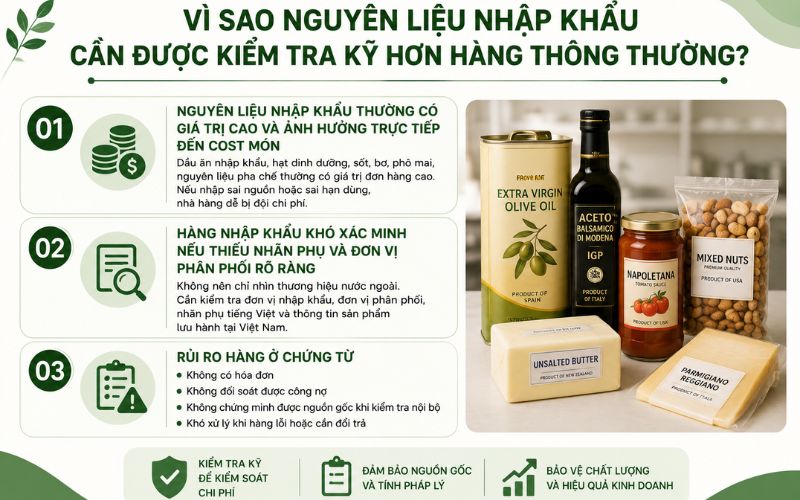
Why do imported raw materials need to be inspected more thoroughly than regular goods?
Imported ingredients are often high-value, go through many intermediaries, and come with different legal requirements compared to domestically produced goods. Therefore, in addition to checking the actual quality upon receipt, restaurants also need to compare documents, importer information, and related certificates to ensure clear origin and minimize risks during business operations.
Imported ingredients are often expensive and directly affect the cost of a dish.
Many imported ingredient groups, such as cooking oil, nuts, sauces, butter, cheese, or blending ingredients, often have large order values and account for a significant proportion of the cost of goods sold. Simply importing the wrong specifications, the wrong brand, or receiving a batch with a short shelf life can significantly increase operating costs.
Besides financial losses, using substandard ingredients also affects food quality, recipe consistency, and customer experience. Therefore, carefully checking product documentation and information before warehousing is essential to protect the restaurant’s profits.
Imported goods are difficult to verify if they lack clear labels and information about the distributor.
Not all products bearing foreign brand names are necessarily officially imported. Restaurants should not rely solely on packaging or brand names to assess the origin of a product.
Instead, you should check the Vietnamese supplementary label, information about the importer or distributor in Vietnam, and other mandatory information displayed on the product. This data helps determine if the product is legally circulating and provides a basis for contacting them for technical support, returns, or to resolve any issues that may arise.
Risk in goods is related to documentation.
Receiving goods without complete documentation can cause many difficulties for restaurants in their management process. Without invoices or delivery slips, businesses will find it difficult to reconcile accounts payable, verify quantities received, and maintain purchase records.
Furthermore, if internal audits are required or proof of origin of ingredients is needed, the lack of documentation will reduce the transparency of the records. In cases of defective goods, incorrect deliveries, or returns, the restaurant will also face many disadvantages if it does not have documentation to support its dealings with the supplier.
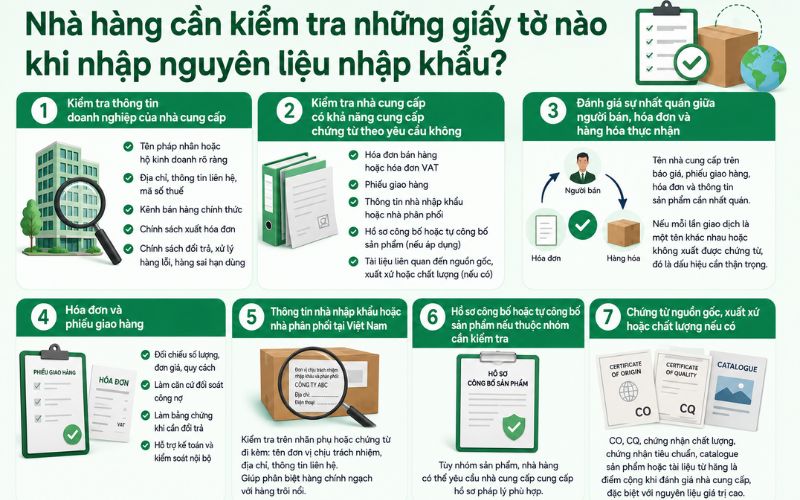
What items should a restaurant check when importing ingredients?
Each group of ingredients may come with a different set of documentation. However, before partnering with a supplier, the restaurant should clearly discuss the items that can be supplied with imported ingredients to facilitate quality control, verification, and record keeping.
Supplier’s business information
Before placing an order, the restaurant should verify the supplier’s basic information, including:
- The legal name of the entity or business household must be clearly stated.
- Complete business address and contact information.
- Tax identification number.
- Official sales channel or website.
- Invoice issuance policy.
- Return and exchange policy, handling of defective goods or goods with expiration dates that do not meet the promised specifications.
A transparent supplier is usually willing to disclose this information and has clear work processes. Conversely, if transactions are conducted through personal accounts, the business entity cannot be identified, or legal information is lacking, the restaurant should reconsider before partnering.
Supplier’s ability to provide documentation
From the outset, the restaurant should clearly ask the supplier what types of documentation they can provide for each product group. Depending on the type of ingredient, the documentation may include:
- Sales invoice or VAT invoice (if required).
- Delivery slip.
- Information about the importer or distributor.
- Product declaration or self-declaration documents (if applicable).
- Documentation relating to the origin, source, or quality of the product, if available.
Note that not all products are required to have the same set of documentation. The required documentation should be based on the characteristics of each product group and the restaurant’s management needs.
Invoice and delivery slip
Invoices and delivery notes are important documents in a restaurant’s purchasing process. These documents help to:
- Compare the quantity, unit price, and product specifications.
- To be used as a basis for reconciling accounts payable with suppliers.
- We provide support for handling returns, exchanges, or complaints.
- To support accounting and internal control functions.
The restaurant should keep all these documents on file for convenient management later on.
Information about the importer or distributor in Vietnam.
For imported ingredients, restaurants should check the information about the importer or distributor shown on the supplementary label or accompanying documents.
Key information to note includes the name of the responsible entity, its address, and contact information. This is crucial for distinguishing legitimately imported goods from products of unknown origin circulating in the market.
Product declaration or self-declaration documents if the product belongs to the group requiring inspection.
For certain food categories, restaurants may request that suppliers provide product declaration documents or self-declare the product in accordance with current regulations if the product falls under applicable categories.
Having the right legal documentation available gives businesses more peace of mind when choosing suppliers and facilitates the process of maintaining high-quality records. However, this requirement may vary depending on the product group.
Certificates of origin, provenance, or quality, if available.
In addition to the basic documents, some providers may also offer additional documents such as:
- Certificate of Origin (CO).
- Quality Certificate (CQ).
- Manufacturer’s standard certification or quality certification.
- Catalogues or technical documents from the manufacturer.
These documents are not always mandatory, but they are a useful reference when evaluating suppliers of high-value imported ingredients or for F&B models requiring stringent quality standards.
Quick checklist for receiving imported materials.
A standardized checklist helps the purchasing, warehousing, and kitchen departments follow the correct inspection procedures at every delivery. Reviewing at each stage not only helps detect errors early but also provides a basis for comparison when complaints or returns arise with suppliers.
Before placing your order
Before confirming an order, the restaurant should check the following:
- Verify the supplier’s business information (legal name, tax identification number, address, contact information).
- Check the official sales channels and the level of transparency of the supplier.
- Standardize product specifications, brand, volume, or weight.
- Inquire beforehand about the types of documents the supplier can provide (invoices, delivery notes, importer information, legal documents if applicable…).
- Standardize the return and exchange policy for defective goods, incorrect deliveries, or goods that have not met the expiration date.
- Discuss the minimum remaining shelf life for ingredients with short shelf lives.
Upon receiving the goods
When the goods arrive, you should inspect them in person before signing for receipt:
- Compare the product name with the order.
- Verify the quantity, specifications, and unit price against the delivery note.
- Check that the packaging is intact, with no tears, dents, or signs of being opened.
- Compare the expiration dates of products within the same batch.
- Check that the Vietnamese supplementary label is complete and clear.
- Verify information regarding origin, importer, or distributor.
- Check the storage conditions of the goods upon delivery (temperature, frozen or chilled status if applicable).
- Compare the invoice, delivery slip, and the actual product received to ensure consistency of information.
- Take photos of the product and documents if you notice any irregularities.
After being received into the warehouse.
After receiving the supplies, the restaurant should follow these steps to manage its ingredients effectively:
- Keep complete records of invoices, delivery notes, and related documents.
- Record the batch number, expiration date, and date of receipt according to internal management procedures.
- Arrange materials according to the principle of prioritizing the use of batches with closer expiration dates (FIFO or FEFO depending on the management model).
- Monitor the quality of raw materials during storage.
- Immediately notify the supplier if you discover any defective or incorrect goods, or if any problems arise after opening the package.
- Update the supplier evaluation results to use as a basis for future orders.
Completing the checklist in all three stages will help restaurants better control the quality of imported ingredients, minimize cost losses, and build a consistent and transparent procurement process.
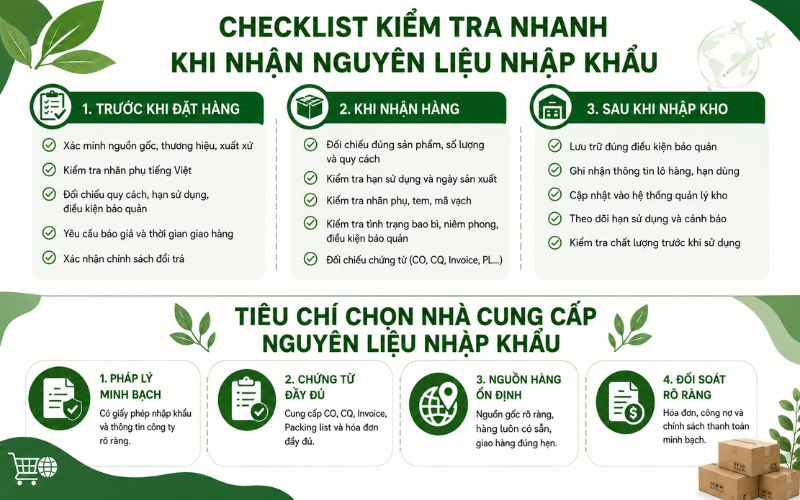
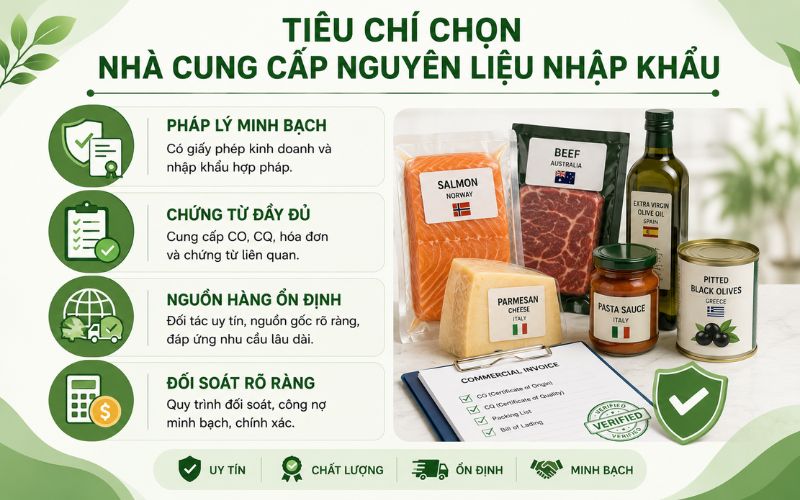
Criteria for selecting imported raw material suppliers
Choosing the right supplier not only helps restaurants ensure the quality of ingredients but also reduces legal, cost, and operational risks. Besides price, F&B businesses should prioritize suppliers with transparent information, stable supply sources, and clear documentation procedures to facilitate long-term partnerships.
Legal transparency
A reputable supplier should publicly disclose complete business information so that customers can easily verify it before making a transaction. This information should include:
- Name of legal entity or business household.
- Tax identification number.
- Address and contact information.
- Official website or sales channel.
- Clear sales and return policies.
Collaborating with a legally compliant supplier gives restaurants greater peace of mind regarding the origin of goods, while also reducing the risk of disputes or the need for after-sales support.
Complete documentation
For imported materials, suppliers should be able to provide the appropriate documentation for each product group and according to customer requirements.
Depending on the type of goods, the documents may include sales invoices or VAT invoices, delivery notes, importer or distributor information, product declaration or self-declaration documents (if applicable), and documents regarding the origin, provenance, or quality of the product, if any.
Having complete documentation helps restaurants easily reconcile records, store files, and handle any issues that arise during the use of ingredients.
Stable supply of goods
For restaurants, cafes, or F&B chains, a stable supply is crucial for maintaining food quality and business plans.
A reliable supplier needs to be able to meet consistent production demands, minimizing shortages or frequent product changes. At the same time, the quality, specifications, and brand of the ingredients must be consistently maintained across deliveries to avoid impacting the recipe and customer experience.
If a restaurant uses high-value imported ingredients, prioritizing suppliers with professional warehousing and supply chain management systems will help reduce the risk of operational disruptions.
Clear reconciliation
A transparent reconciliation process helps both restaurants and suppliers work more efficiently throughout the collaboration.
Suppliers should provide clear quotations, documentation consistent with the actual goods, complete invoices and delivery notes, and specific regulations regarding payment terms, debt handling, and return/exchange policies in case of defective or incorrect goods.
A clear reconciliation process not only saves time for the purchasing and accounting departments but also reduces disputes, laying the foundation for a long-term collaborative relationship between the two parties.
How does Kamereo assist restaurants in controlling their supply chain and import documentation?
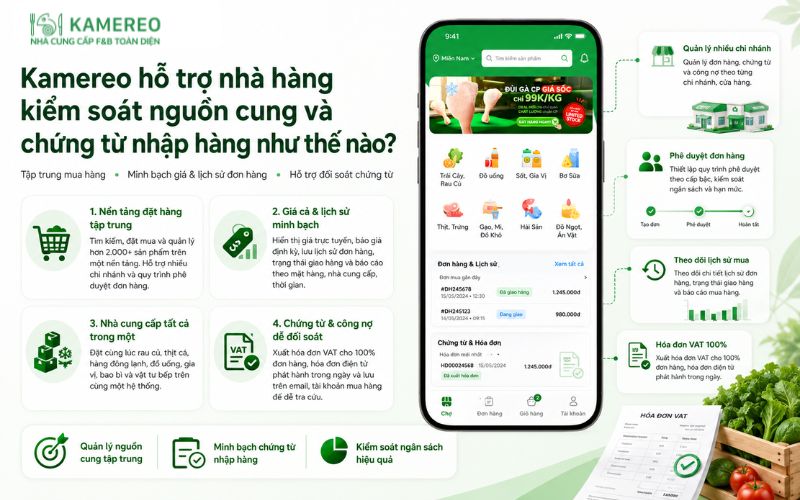
Managing multiple suppliers simultaneously poses significant challenges for many restaurants in terms of ordering, tracking documentation, and reconciling accounts payable. Kamereo, a wholesale food supplier application for F&B businesses, helps centralize the purchasing process on a single system, thereby saving management time and improving operational efficiency.
A centralized ordering platform reduces reliance on multiple fragmented sources.
Instead of having to order through multiple channels, calling or texting each supplier, Kamereo allows restaurants to search, order, and manage over 2000+ products on a single platform. This significantly reduces order processing time and minimizes errors when working with multiple partners.
For restaurant or cafe chains with multiple branches, the system also supports managing multiple stores under a single account, tracking orders by branch, and establishing order approval processes. This allows businesses to better control their budgets, limit unplanned purchases, and synchronize procurement data across the entire system.
Transparent pricing and order history.
Kamereo displays product prices online on its website and app, and sends periodic price quotes so businesses can proactively monitor price fluctuations and plan their purchases. All transactions are recorded in the system, allowing restaurants to easily look up order history, track delivery status, and cross-reference information when needed.
Additionally, the platform provides reports by item, supplier, and time period, helping purchasing and accounting departments analyze costs, compare import prices, and optimize budgets more effectively.
A diverse range of products, suitable for the wholesale purchasing needs of restaurant kitchens.
Kamereo operates on an “all-in-one supplier” model, offering over 2,000+ products for the F&B business. The product catalog includes fresh and frozen foods, fruits and vegetables, beverage ingredients, drinks, spices, packaging, and many professional kitchen supplies.
Consolidating multiple product categories on a single platform helps restaurants reduce reliance on numerous individual suppliers, simplify the purchasing process, and save time managing orders.
Clear operating procedures help restaurants reduce risks when sourcing ingredients.
Kamereo has established a synchronized operational process from ordering, quality control, delivery, to document management, giving businesses peace of mind during the import process. The 4-layer quality control system, combined with modern warehousing and a joint inspection policy upon receipt, helps minimize risks related to raw material quality before use.
In addition, Kamereo issues VAT invoices for 100% of orders, with electronic invoices issued on the same day of delivery (including weekends and holidays), automatically sent via email, and stored in the purchasing account. This makes it easy for restaurants to look up documents, reconcile accounts payable, support accounting work, and reduce the risk of lost records during operation.
Summary
Checking import documents and expiration dates of imported ingredients is a crucial step in helping restaurants control the quality of their input, ensuring clear origin and quality.Reduce operational risks. If you are looking for a transparent purchasing solution with a stable supply, complete documentation, and a professional process, explore our solutions. Kamereo to optimize procurement operations for F&B businesses.
See more: