

 0812 46 37 27



Switching food suppliers is a crucial decision that directly impacts food quality, operating costs, and customer experience. To ensure a smooth transition, restaurants need thorough preparation, from evaluating new suppliers and checking product quality to managing inventory and contracts.Let’s go together Kamereo refer to the food supplier switching checklist below to minimize risks and ensure business stability.
Why do F&B businesses need to prepare a checklist before changing suppliers?
Switching food suppliers is not simply a change of where to buy from; it directly impacts the entire operational chain of an F&B business. From food quality, ingredient quantities, and food costs to warehousing, receiving, and accounts receivable processes, everything can be affected if the transition is not carefully prepared.
Before changing suppliers, businesses need to review and standardize key data such as ingredient lists, product specifications, usage quantities, safe inventory levels, delivery schedules, and payment procedures. This forms the basis for seamless coordination between the purchasing, kitchen, warehouse, and accounting departments during the transition period.
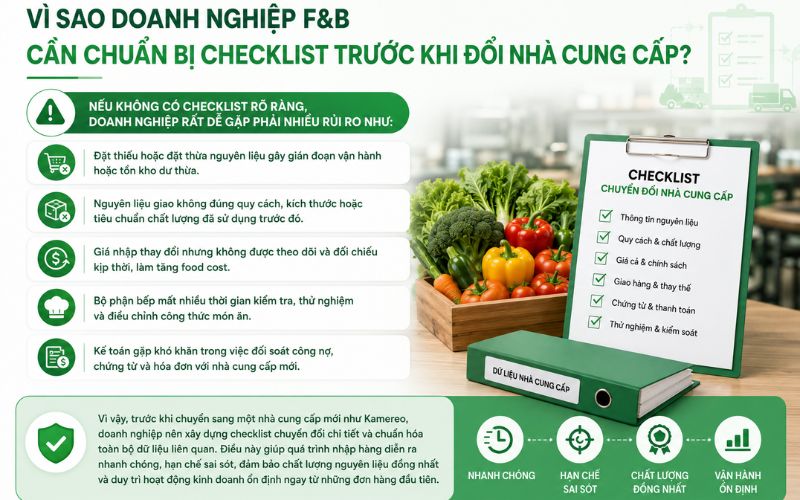
Without a clear checklist, businesses are very likely to encounter many risks such as:
- Under-ordering or over-ordering materials can cause operational disruptions or excess inventory.
- The delivered materials did not meet the specifications, dimensions, or quality standards previously used.
- Import prices fluctuate but are not tracked and reconciled in a timely manner, leading to increased food costs.
- The kitchen staff spends a lot of time checking, testing, and adjusting recipes.
- The accountant is having difficulty reconciling accounts payable, supporting documents, and invoices with the new supplier.
Therefore, before switching to a new supplier, businesses should create a detailed transition checklist and standardize all related data. This helps to speed up the procurement process, minimize errors, ensure consistent material quality, and maintain stable business operations right from the first orders.
What should be evaluated in a vendor switching checklist?
To ensure a smooth food supplier transition, F&B businesses need to prepare comprehensive data related to ingredients, operations, quality, finance, and purchasing processes. A detailed checklist not only helps assess the suitability of the new supplier but also minimizes operational disruption risks, effectively controls food costs, and shortens the adaptation period after the switch.
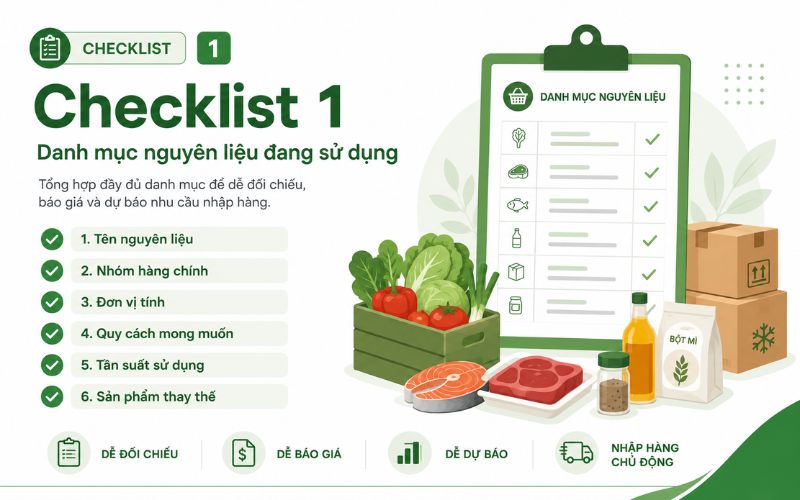
Checklist 1: List of ingredients currently in use
This step helps businesses review their entire current purchasing portfolio, avoiding situations where they only partially switch suppliers but still have to source materials from multiple different sources. Gathering comprehensive data also helps assess the new supplier’s ability to meet their product portfolio needs.
The items that need to be prepared include:
- Name of the raw material being imported: List all the ingredients currently in use to compare with the new supplier’s list.
- Product group: Vegetables and fruits; Meat, fish, seafood, Frozen food, Dry goods, Spices, sauces, Ingredients for mixing, Consumable materials
- Units of measurement currently in use: Clearly state the unit of measurement such as kg, gram, bundle, box, bottle, package, tray, etc., to avoid discrepancies when quoting prices and placing orders.
- Desired specifications: Determine the size, weight, level of preparation, and packaging requirements that are suitable for kitchen operations.
- Frequency of use: Analyze daily usage patterns, frequency of use (several times/week), seasonal usage, and menu-based usage to make more accurate product demand forecasts.
- List of acceptable replacement products: Prepare alternative plans in case the main product runs out of stock or its price fluctuates.
Kamereo currently offers an “all-in-one” model with over 3,000 products serving the F&B business, from fresh and frozen foods to dry goods, beverage ingredients, and consumables. This allows restaurants to centralize their purchasing on a single platform instead of managing multiple different suppliers.
Checklist 2: Ingredient Standard Data per Dish
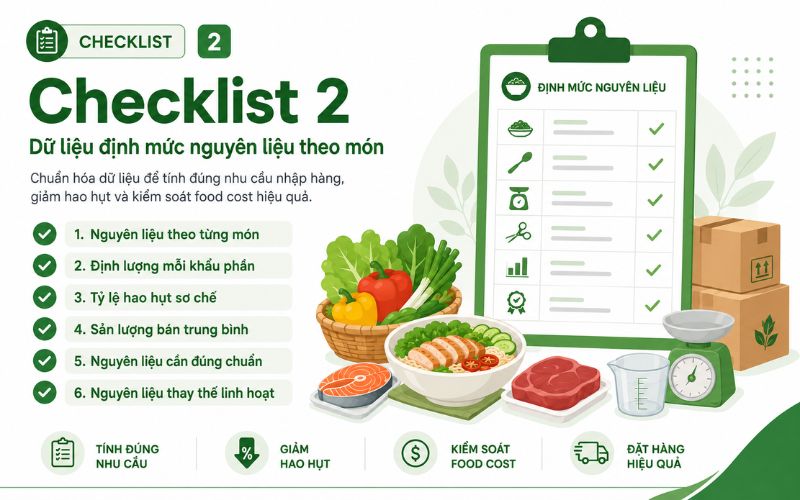
Standard data helps businesses accurately calculate their inventory needs, minimize waste, and control food costs more effectively when switching to a new supplier.
The items that need to be prepared include:
- What ingredients are being used in each dish?: List all the constituent ingredients to facilitate comparison with the new supplier’s list.
- Determine the quantities of ingredients for each serving: Determine the exact amount of ingredients to use for each dish or drink.
- Loss rate during initial processing: Record actual losses to calculate inventory needs more accurately.
- Average daily or weekly sales volume: Used to forecast raw material demand and plan orders accordingly.
- The ingredients must meet the required standards: Identify the ingredients that directly affect the quality and flavor of the dish.
- Ingredients can be flexibly substituted: Clarify which ingredients can be swapped for equivalent products if necessary.
Examples of data that should be included.
| Dish | Main ingredients | Quantity/dish | Expected loss | Note |
|---|---|---|---|---|
| Chicken salad | Salad | 80g | 5–10% | We need fresh, crisp leaves. |
| Beef rice | Beef | 120g | 3–5% | Slice thinly |
| Juice | Carrot | 150g | 10–15% | Prioritize bulbs of uniform size. |
For fruits and vegetables, Kamereo offers a wide range of options in terms of size and weight, allowing businesses to order exactly what their kitchens need, thereby reducing waste and optimizing inventory.
Checklist 3: Current Order and Delivery Schedule
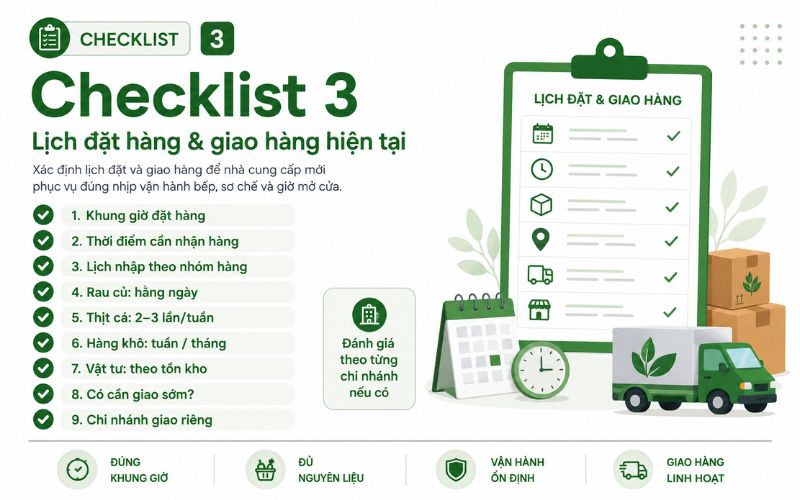
The order and delivery schedule serves as a basis for new suppliers to develop appropriate service plans, avoiding disruptions to food preparation, kitchen operations, and customer service.
The items that need to be prepared and evaluated include:
- What time slots are businesses placing orders during?
- When do you need to receive the goods?
- Do each product group have a different import schedule?
- Vegetables: daily.
- Fish: 2–3 times/week.
- Dry goods: delivered weekly or monthly.
- Consumable materials: based on inventory.
- Do you need the delivery early, before opening hours?
- Are there any branches that require separate deliveries?
Kamereo supports orders placed until midnight and deliveries starting at 6 AM the following day, allowing restaurants to proactively prepare ingredients before opening. The company also commits to an on-time delivery rate of over 99%, contributing to the stability of the supply chain.
Checklist 4: Purchase price data and purchasing budget
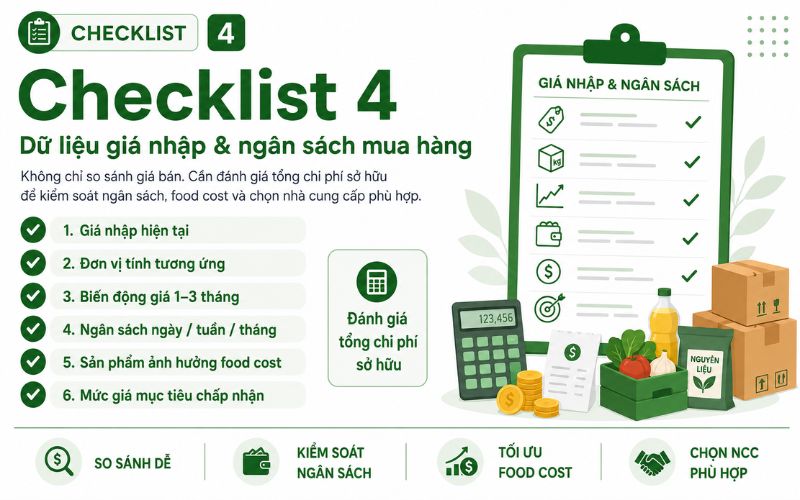
When evaluating new suppliers, businesses shouldn’t just compare prices of individual products. Instead, they should assess the total cost of ownership, including purchase price, spoilage rate, product quality, supply stability, delivery costs, order processing time, and related management costs, to gain a comprehensive view and make a more informed decision.
The items that need to be prepared and evaluated include:
- Current import prices for each product: This serves as a basis for comparison with quotes from new suppliers.
- Corresponding unit of measurement: It helps to accurately compare price quotes and sales specifications.
- Price fluctuations over the last 1–3 months: Assess the stability of raw material costs.
- Inventory budget by day, week, or month: Determine the supplier’s ability to meet the budget.
- These products have a significant impact on food costs: Prioritize thorough evaluation of items that directly impact profitability.
- The target price or acceptable price range: To serve as a basis for negotiation and selection of suitable suppliers.
To accurately assess the financial effectiveness of switching suppliers, businesses should prioritize those with transparent, easily traceable pricing policies that support long-term budget control.
Kamereo publicly displays prices directly on its website and app, making it easier for businesses to compare prices, track price fluctuations, and plan their purchasing budgets more transparently. In addition, prices are maintained stably for 7 days, helping restaurants and eateries monitor their inventory budgets more easily.
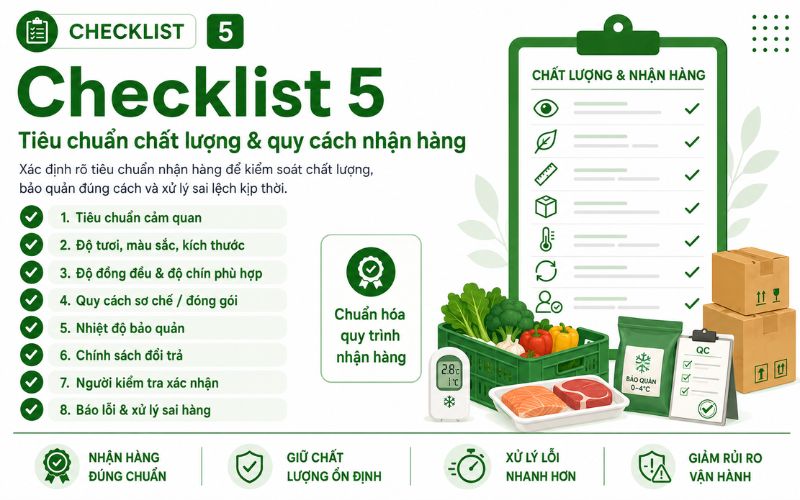
Checklist 5: Quality standards and delivery procedures
One common reason why switching suppliers is difficult is that businesses haven’t clearly agreed on input quality standards. Even with the same type of material, differences in size and texture can be significant.freshThe level of preparation or packaging specifications can affect food quality, usage rates, and kitchen operational efficiency. Therefore, before starting a partnership with a new supplier, businesses need to establish specific acceptance standards to ensure that all shipments meet the requirements.
The items that need to be prepared and evaluated include:
- Sensory criteria for each product group:
- Freshness.
- Color.
- Size.
- Uniformity.
- The appropriate level of maturity or ripeness.
- Desired processing and packaging specifications.
- Temperature requirements for storing chilled, refrigerated, and frozen goods.
- Return and exchange policy for products that do not meet standards.
- The person in charge will inspect and verify the quality upon receipt of the goods.
- Procedures for recording, reporting, and handling cases of incorrect deliveries or goods that do not meet requirements.
Standardizing these criteria from the outset helps the purchasing, warehousing, and kitchen departments evaluate goods consistently, minimizing disputes between parties and reducing the risk of affecting food quality.
Kamereo applies a four-tiered quality control process from sourcing, procurement centers, warehousing to delivery. In addition, businesses can conduct joint inspections upon receipt and receive prompt support in resolving any issues, helping to ensure more consistent raw material quality throughout operations.
Checklist 6: Branch data, order placers, and order approvers
For F&B businesses with multiple branches, switching suppliers involves not only sourcing goods but also impacts internal ordering, approval, and cost control processes. If information regarding responsible personnel and delivery locations isn’t standardized from the outset, businesses may encounter issues like duplicate orders, incorrect deliveries, delayed approvals, or difficulties in reconciliation between departments.
Therefore, before working with a new supplier, businesses need to thoroughly review and update all data related to their branch network and current purchasing processes.
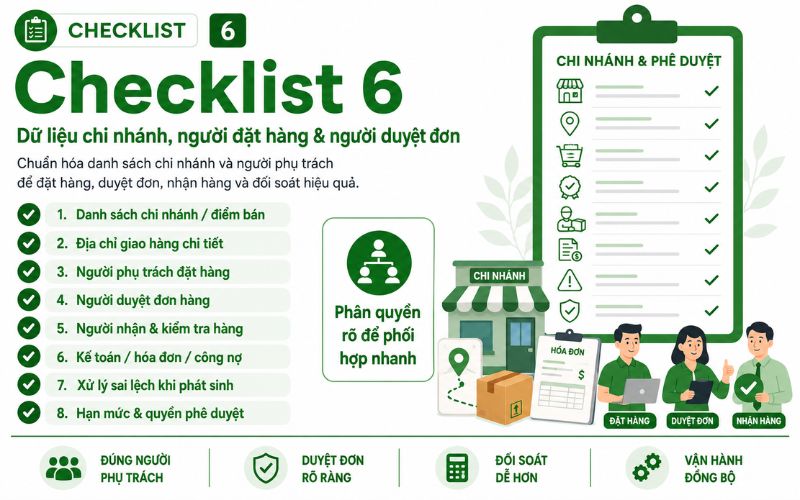
The items that need to be prepared and evaluated include:
- A complete list of all branches, stores, or points of sale that require delivery.
- Detailed delivery addresses for each branch.
- The person in charge of placing orders at each location.
- The person authorized to approve the order.
- The person who directly receives and inspects the goods.
- The person in charge of accounting, invoicing, or accounts receivable reconciliation.
- Procedures for handling discrepancies in quantity, quality, or documentation.
- Regulations regarding order limits and approval authority for each department (if any).
Standardizing this information helps businesses build a unified purchasing process across branches, reducing operational errors and increasing budget control. Simultaneously, the data enables new suppliers to establish delivery plans, issue invoices, and provide customer support more quickly.
Kamereo helps businesses manage multiple branches on a single purchasing account. The system allows for user permission control for order placement and approval, centralized tracking of transaction history, invoices, and orders, helping F&B chains optimize their purchasing processes and control costs more effectively.
Checklist 7: Invoice information, accounts payable, and reconciliation
When switching suppliers, many businesses often focus on product quality and import price, neglecting the standardization of invoice information, accounts payable, and reconciliation processes. However, these factors directly impact accounting, cash flow management, and cost control. Without proper data preparation from the outset, businesses may waste time correcting errors, requesting invoice adjustments, or manually reconciling between departments.
To ensure a smooth collaboration with a new supplier, businesses should agree in advance on information and procedures related to documentation, payments, and accounts payable.
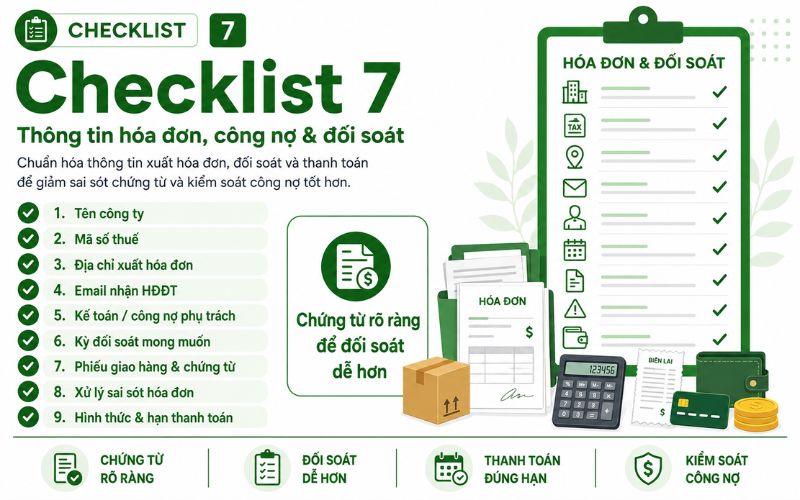
The items that need to be prepared and evaluated include:
- Company name as registered in business registration information.
- Tax identification number.
- Invoice address.
- Email to receive electronic invoices.
- The person in charge of accounting or accounts receivable.
- Desired reconciliation period (weekly, monthly, or on a specific cycle).
- Requirements include delivery notes, delivery receipts, and related documents.
- Procedure for handling errors in invoices or documents.
- Payment methods and terms apply.
Standardizing this information helps businesses shorten document processing time, reduce errors in tax declarations, and improve accounts receivable management efficiency. At the same time, it provides a basis for suppliers to establish invoicing and reconciliation processes that meet the specific requirements of each business.
Kamereo issues VAT invoices for 100% of orders, which are sent directly via email and stored in the purchasing account. Businesses can easily look up transaction history, manage documents, and perform accounts receivable reconciliation more quickly and conveniently.
Checklist 8: List of products to test before switching suppliers
Switching suppliers doesn’t necessarily have to be done across the entire raw material portfolio. In fact, many F&B businesses choose to test a few key product groups first to assess product quality, supply stability, and the ability to meet operational requirements. This approach minimizes risk while allowing the kitchen, warehouse, and purchasing departments to familiarize themselves with the new supplier before expanding the partnership.
Testing products in groups also provides businesses with a practical basis for comparing quality, loss rates, costs, and efficiency with their current suppliers.
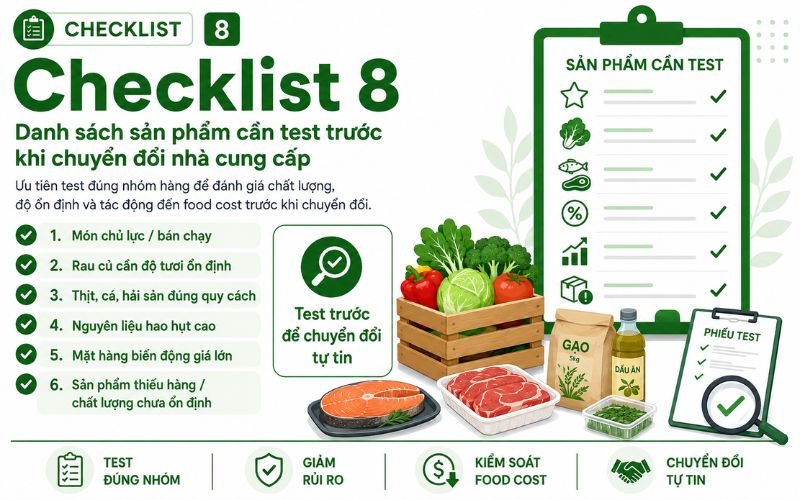
Which product categories should be tested?
- Ingredients directly influence the signature dishes or best-selling products.
- Fruits and vegetables have high requirements for freshness and stability.
- Meat, fish, and seafood need to be cut, portioned, or prepared according to proper procedures.
- The raw materials have a high loss rate during processing.
- Items with significant price fluctuations directly impact food costs.
- Products that are frequently out of stock or of inconsistent quality from the same supplier.
During the trial phase, businesses should monitor criteria such as actual quality upon receipt, spoilage rate, compliance with specifications, delivery time, and the ability to handle arising issues. This will be a crucial basis for making decisions about completely switching or adjusting the purchasing portfolio accordingly.
Kamereo allows businesses to start with core product categories first, then gradually expand to other categories as product quality, pricing, and delivery processes better meet the actual operational needs of the restaurant or F&B chain.
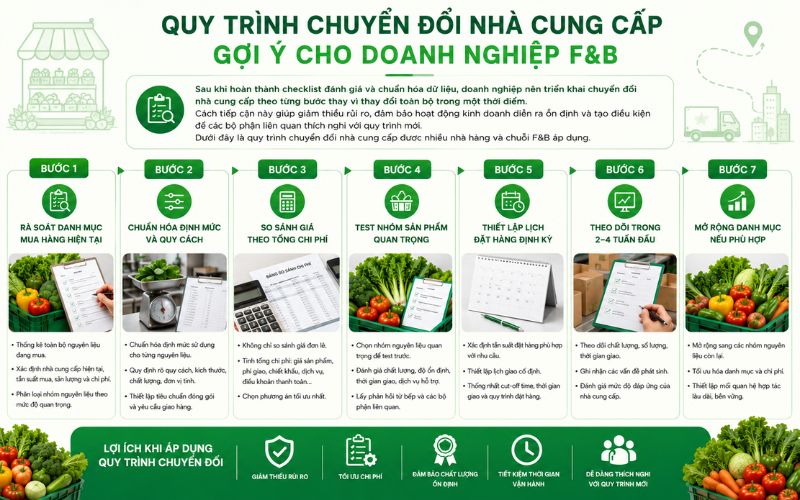
Suggested supplier switching process for F&B businesses.
After completing the checklist for evaluating and standardizing data, businesses should implement supplier switching in stages rather than changing everything at once. This approach minimizes risk, ensures stable business operations, and allows relevant departments to adapt to the new process. Below is a supplier switching process commonly used by restaurants and F&B chains.
Step 1: Review your current shopping list.
Businesses need to compile a complete list of all raw materials currently in use, including the product categories being purchased, consumption volume, ordering frequency, and current suppliers. This forms the basis for evaluating the responsiveness of new suppliers and identifying priority product categories for switching suppliers.
Step 2: Standardize specifications and standards
Before starting the procurement process, it’s essential to clearly agree on the quantity of ingredients, quality standards, processing methods, dimensions, and packaging for each product. Standardizing this from the outset helps reduce discrepancies during delivery and ensures the kitchen receives ingredients that meet operational requirements.
Step 3: Compare prices based on total cost.
Prices shouldn’t be compared solely by kilogram or unit. Businesses need to assess the total actual costs, including spoilage rates, delivery costs, invoicing capabilities, order processing time, and supply chain stability. This is a more accurate way to evaluate the effectiveness of a long-term partnership.
Step 4: Test the key product group.
Instead of switching the entire product catalog immediately, businesses should prioritize testing product categories that directly impact food quality or food costs. This process allows the kitchen staff to assess the actual quality of ingredients and provide feedback before scaling up procurement.
Step 5: Set up a recurring order schedule.
After completing the initial testing phase, the business needs to agree on ordering schedules, delivery schedules, and procedures for handling any issues with the new supplier. A suitable delivery schedule will help optimize inventory, minimize shortages, and ensure uninterrupted kitchen operations.
Step 6: Monitor during the first 2–4 weeks
The initial phase after the transition is a crucial time to assess the supplier’s actual capabilities. Businesses should monitor metrics such as product quality, on-time delivery rate, on-time delivery rate, price stability, feedback from the kitchen staff, and the status of invoice and accounts receivable reconciliation.
Step 7: Expand the category if appropriate.
Once a new supplier successfully meets the requirements for quality, price, and service, the business can gradually expand to include other product categories. Concentrating multiple product categories on a single platform or with a reputable supplier not only saves management time but also improves cost control and supply chain operations.
Sample checklist for switching suppliers in the F&B business.
Switching suppliers becomes simpler and more efficient when businesses have a clear evaluation process from the outset. Instead of spending time compiling data from multiple departments, businesses can use a template checklist to review material lists, usage rates, delivery schedules, quality standards, accounts payable, and critical operational requirements before switching.
This checklist is particularly suitable for restaurants, cafes, central kitchens, and F&B chains looking to optimize purchasing operations, reduce supply chain disruption risks, and control costs more effectively.
Kamereo – The optimal wholesale food supply solution for F&B businesses.
If your F&B business is struggling with working with multiple suppliers, manually tracking orders, or spending a lot of time reconciling accounts payable, Kamereo could be the solution to simplify the entire purchasing process.CamerastheSuitable for businesses looking to transition from a fragmented purchasing model to a more centralized, transparent, and controllable ordering process.
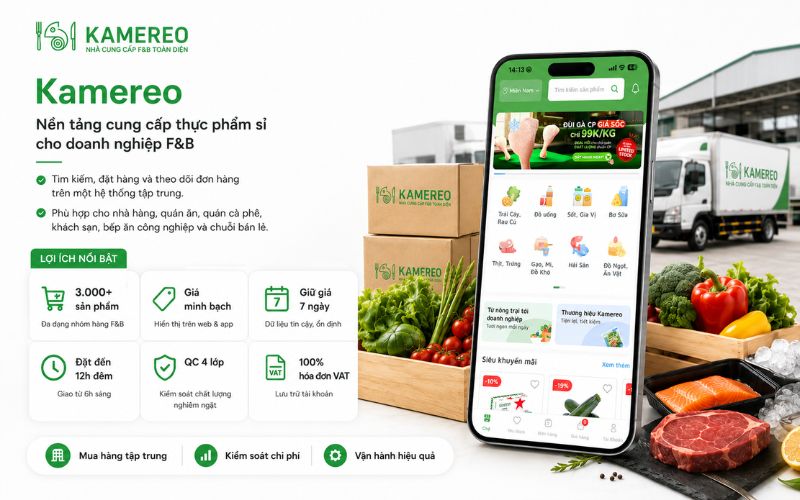
Kamereo is a wholesale food supply platform for businesses, supporting restaurants, eateries, cafes, hotels, industrial kitchens, and retail chains in managing their procurement operations on a centralized system. Instead of contacting multiple different suppliers, businesses can search, order, and track orders all on the same platform.
To help businesses optimize their purchasing processes and control costs more effectively, Kamereo offers several outstanding benefits:
- Catalog of over 3,000 products: Kamereo offers a diverse range of products for the F&B industry, including fruits and vegetables, meat, fish, seafood, frozen foods, dry goods, beverage ingredients, and consumables. This allows businesses to easily expand their purchasing portfolio without having to work with too many individual suppliers.
- Prices are transparent on the website and app: All selling prices are publicly available on the platform, making it easier for businesses to track procurement costs, compare prices, and control their budgets more effectively during operations.
- Keep prices stable for 7 days: This policy helps F&B businesses proactively plan their purchasing, budget, and manage food costs more effectively in the face of market fluctuations.
- Orders placed before midnight will be delivered starting at 6 AM: Kamereo meets the flexible sourcing needs of restaurants, cafes, and professional kitchens, ensuring businesses always have enough ingredients for their daily operations.
- 4-layer quality control: Quality control processes are applied throughout the entire process, from procurement and warehousing to delivery, helping to minimize risks related to the quality of raw materials and ensuring that products reach customers according to the committed standards.
- VAT invoice support for 100% of orders: Invoices are issued on the day of delivery and stored directly in the purchase account, making it easier for businesses to manage documents, reconcile accounts payable, and perform accounting tasks.
With its diverse product portfolio, transparent pricing, stable supply, and centralized purchasing process, Kamereo is the right choice for F&B businesses looking to optimize procurement, save management time, and improve supply chain operational efficiency.
Summary
Switching suppliers is an opportunity for F&B businesses to optimize purchasing, control costs, and improve operational efficiency. With the right checklist and a clear implementation roadmap, businesses can reduce risks and ensure a stable supply. If you are looking for a centralized, transparent, and easy-to-manage supply chain solution, Kamereo is a worthwhile option.