

 0812 46 37 27



Many eateries, restaurants, and cafes often start by sourcing ingredients from wholesale markets or familiar suppliers to optimize costs. However, as the business expands, the sourcing problem is no longer just about low prices but also involves product quality, invoices and documentation, delivery times, supply stability, and delivery capabilities.
In reality, the source of supplies directly affects the quality of food and beverages, while the method of sourcing significantly impacts kitchen operations and staffing efficiency. A low price isn’t necessarily the optimal choice if it comes with hidden costs such as spoilage, shortages, or time-consuming procurement. In this article, we will compare three common models: wholesale markets, warehouses, and B2B suppliers, to find the right solution for each stage of F&B business development.
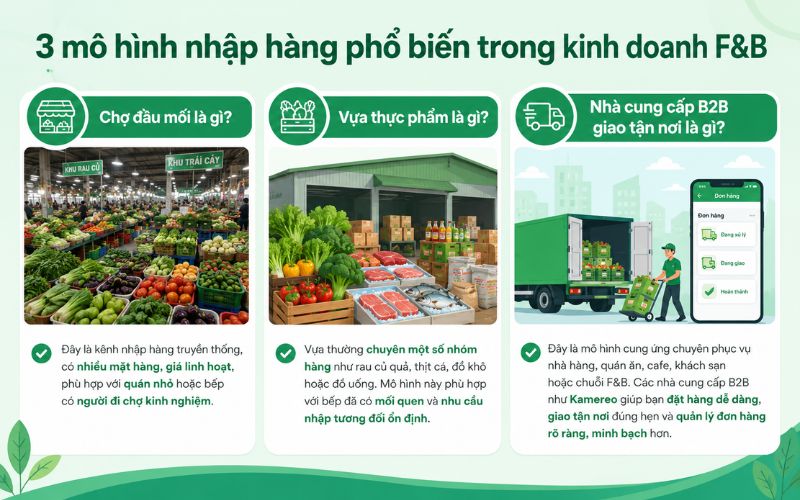
3 common sourcing models in the F&B business.
Wholesale market
Wholesale markets are a traditional sourcing channel chosen by many eateries, restaurants, and cafes in their initial stages of business. Here, buyers can find a wide variety of goods, from fruits and vegetables, meat, fish, seafood, and dried goods to beverages, in large quantities and at relatively flexible prices.
A major advantage of wholesale markets is that buyers can directly select goods, easily negotiate prices, and proactively check quality before purchasing. This model is particularly suitable for small restaurants or kitchens with experienced staff who understand the supply chain and price fluctuations at different times.
Food warehouse
A food wholesaler is a model that supplies goods specifically categorized by product group, such as fruits and vegetables, meat, fish, seafood, dried goods, or beverages. Instead of buying from many different small traders, restaurants can work directly with a single supplier specializing in a particular group of ingredients.
This model is suitable for kitchens that already have established relationships and relatively stable supply needs. By understanding customer needs, many wholesalers can prepare goods in advance and offer delivery, saving time compared to going to the market every day.
B2B supplier delivers to your door.
B2B suppliers are a supply chain model specializing in providing ingredients for F&B businesses such as restaurants, cafes, hotels, or chain stores. Instead of ordering from multiple sources, customers can purchase a diverse range of products on a single platform or from a single supplier.
The key features of this model are its ability to quickly place orders, deliver to the customer’s location, provide transparent invoices and documentation, and have a clear order management process. Platforms like Kamereo also help businesses track purchase history, control costs, and ensure a stable supply, optimizing kitchen operations during business expansion.
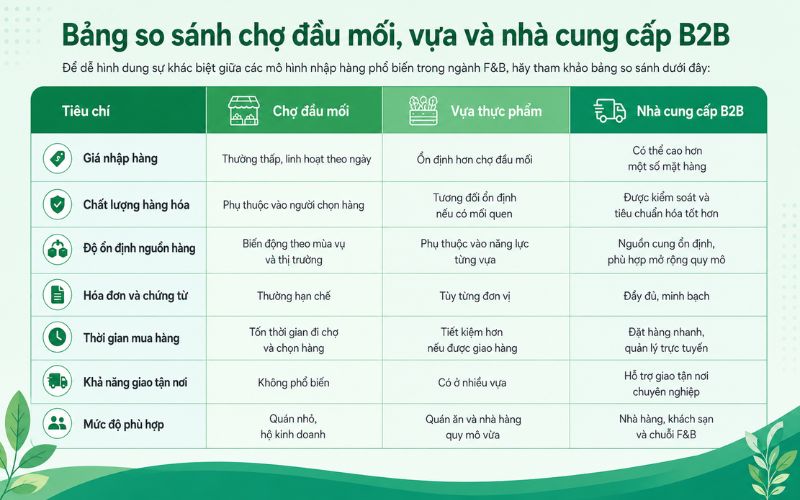
Comparison table of wholesale markets, warehouses, and B2B suppliers.
To better understand the differences between common sourcing models in the F&B industry, please refer to the comparison table below:
|
Criteria |
Wholesale market |
Food warehouse |
B2B supplier |
|
Import price |
Usually low, fluctuating daily. |
More stable than wholesale markets. |
Some items may be more expensive. |
|
Product quality |
It depends on the person choosing the item. |
It’s relatively stable if you have connections. |
Better controlled and standardized |
|
Supply stability |
Seasonal and market fluctuations |
It depends on the capacity of each warehouse. |
Stable supply, suitable for scaling up. |
|
Invoices and receipts |
Usually limited |
Depending on the unit |
Complete and transparent |
|
Purchase time |
It takes time to go to the market and choose goods. |
Save more if you get delivery. |
Fast ordering, online management |
|
Delivery available |
Not common |
Available at many warehouses |
Professional door-to-door delivery support |
|
Level of suitability |
Small shop, household business |
Medium-sized eateries and restaurants |
Restaurants, hotels, and F&B chains |
Advantages and disadvantages of buying from wholesale markets.
Wholesale markets offer significant advantages in terms of flexible pricing, abundant supply, and the ability to directly select products that suit business needs. For experienced buyers, this is a highly effective channel for optimizing input costs.
However, this model requires significant time and effort for shopping, inspecting goods, and transporting them to the kitchen. Product quality may also be inconsistent between purchases. As the business grows or branches open, relying on individual shoppers will make standardizing operations difficult.
Advantages and disadvantages of sourcing goods from wholesalers.
Wholesale food distribution is a suitable option for kitchens that have established long-term relationships with suppliers. By understanding customer needs, many wholesale distributors can deliver regularly, offer flexible quantities, and quickly process any unexpected orders.
However, product quality, invoicing capabilities, and supply capacity often depend on the size of each wholesaler. If demand spikes or expands to multiple business locations, some wholesalers may struggle to simultaneously meet both production volume and stability requirements.
Advantages and disadvantages of ordering through a B2B supplier.
B2B suppliers are suitable for F&B businesses looking to build a more professional and easily controllable procurement process. Key advantages include door-to-door delivery, complete documentation, a stable supply of goods, and centralized order management. This reduces purchasing time, minimizes errors, and supports more efficient business expansion.
However, the selling price of some items may not be the lowest on the market at any given time. Therefore, business owners should evaluate based on total operating costs, including staffing time, transportation costs, spoilage rates, and the ability to maintain consistent quality, rather than just comparing the initial purchase price.
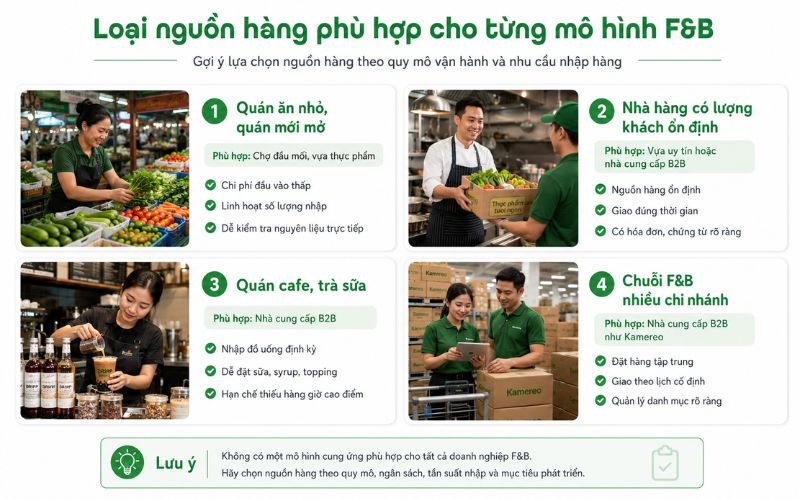
Which suppliers should I choose for my F&B kitchen?
No single supply chain model is suitable for all F&B businesses. Sourcing should be based on the scale of operations, budget, frequency of orders, and development goals of each business model. Below are some suggestions to help restaurant owners choose the right solution.
Small restaurant, newly opened.
For newly opened or small-scale restaurants, wholesale markets and food suppliers are often a popular choice due to low input costs and flexibility in the purchasing process.
This model allows the owner to directly check the quality of ingredients, proactively adjust the quantity purchased according to actual needs, and reduce cash flow pressure in the initial stages. However, as the number of customers increases, dedicating significant time to the procurement process can become an operational challenge.
The restaurant has a steady stream of customers.
Once a restaurant has a relatively stable customer base, the important factors are not only the purchase price but also the ability to maintain the quality of ingredients and optimize operational processes.
At this stage, restaurant owners should consider partnering with reputable food wholesalers or B2B suppliers. Having a stable supply, on-time delivery, and complete documentation will significantly reduce procurement time, while also supporting more effective cost and inventory control.
Cafes, bubble tea shops, and other businesses that require regular beverage deliveries.
Cafes, bubble tea shops, or other beverage businesses typically have a regular need to stock up on products such as milk, syrups, toppings, tea, coffee, and beverage ingredients.
In this case, a B2B supplier like Kamereo could be a suitable solution due to its centralized ordering capabilities, fixed delivery schedules, and clear product catalog management. This helps the restaurant avoid ingredient shortages during peak hours and reduces the time spent working with multiple different suppliers.
The F&B chain has many branches.
Cafes, bubble tea shops, or other beverage businesses typically have a regular need to stock up on products such as milk, syrups, toppings, tea, coffee, and beverage ingredients.
In this case, a B2B supplier like Kamereo could be a suitable solution due to its centralized ordering capabilities, fixed delivery schedules, and clear product catalog management. This helps the restaurant avoid ingredient shortages during peak hours and reduces the time spent working with multiple different suppliers.
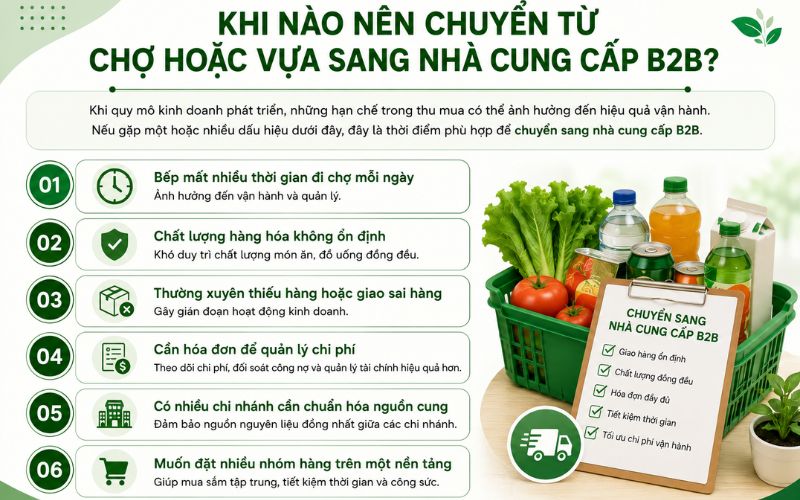
When should you switch from markets or wholesalers to B2B suppliers?
In the initial stages, wholesale markets or food depots can adequately meet the operational needs of a restaurant. However, as the business grows, limitations in procurement begin to emerge and directly impact operational efficiency. If your business is experiencing one or more of the following signs, it may be a good time to consider switching to a B2B supplier model.
- The kitchen staff spend a lot of time shopping for groceries every day. The increasing amount of time spent on purchasing is impacting operations and management.
- The quality of goods is inconsistent. The fluctuating ingredients between shipments make it difficult to maintain consistent quality in food and drinks.
- Frequent shortages or incorrect deliveries. Shortages of raw materials or receiving the wrong products can disrupt business operations.
- Invoices are needed to manage expenses. Businesses need complete documentation to track expenses, reconcile accounts payable, and manage finances more effectively.
- There are many branches that need to standardize their supply chain. A multi-store system requires a consistent supply of raw materials to ensure product quality.
- Want to list multiple product categories on one platform? Centralized purchasing helps reduce the time spent dealing with multiple different suppliers.
Overall, the decision to switch from wholesale markets or warehouses to B2B suppliers should not be based solely on the purchase price of each item. More importantly, it should consider the potential for saving time, controlling quality, managing costs, and supporting long-term business expansion.
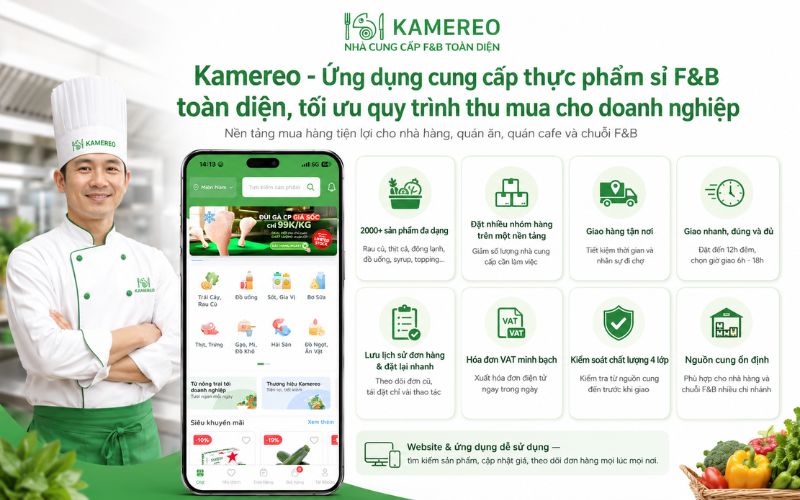
Kamereo – A comprehensive wholesale F&B food and beverage application that optimizes the procurement process for businesses.
As the F&B business expands, managing multiple suppliers, tracking orders, and controlling procurement costs can become a significant challenge. Instead of working with numerous individual suppliers, many businesses are now opting for B2B sourcing platforms to centralize purchasing and optimize operations.
Kamereo is one of the wholesale food supply solutions for F&B businesses with many outstanding advantages:
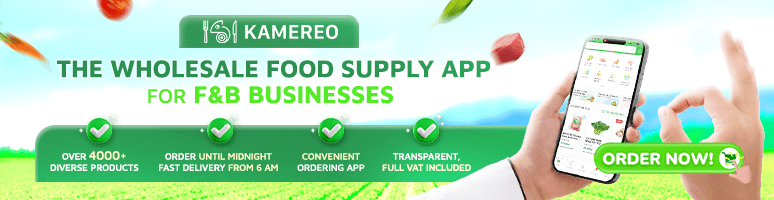
- Place multiple product categories on the same platform: Kamereo offers a diverse range of over 2000+ products, including fruits and vegetables, meats and fish, frozen foods, beverages, beverage ingredients, syrups, toppings, and many other essential items. This helps businesses reduce the number of suppliers they need to work with and simplify their procurement process.
- Home delivery available: Goods are delivered directly to restaurants, eateries, or shops, reducing the time and manpower spent on daily grocery shopping or manual sourcing.
- Flexible, fast, accurate, and complete delivery: Customers can place orders until midnight and choose delivery times between 6 AM and 6 PM to suit their operational needs. The delivery process is optimized to minimize stock shortages or disruptions to business operations.
- Store your order history and reorder quickly: The system stores the entire purchase history, making it easy for users to track their orders. The quick reorder feature allows for reordering recurring items with just a few simple steps.
- Transparent VAT invoices: Kamereo supports issuing electronic VAT invoices for all orders. Invoices are issued on the same day of delivery and stored online, making it easier for businesses to reconcile costs and manage documents.
- 4-layer quality control: The product undergoes quality checks at the source, purchasing center, distribution warehouse, and before delivery to the customer. This process, combined with cold storage, cool storage, and appropriate preservation standards, ensures product quality.
- Stable supply: Kamereo builds long-term supply networks to maintain a consistent supply of goods. This is crucial for restaurants with a steady stream of customers or F&B chains that need to standardize ingredients across multiple branches.
- Convenient website and app for shopping: Users can easily search for products, update prices, track orders, and manage purchasing activities anytime, anywhere on both the website and mobile app.
With its diverse product range, flexible delivery options, and efficient purchasing management support, Kamereo is a suitable choice for F&B businesses seeking a more centralized and professional procurement solution.
Frequently Asked Questions
Are wholesale markets always cheaper than B2B suppliers?
Not necessarily. Wholesale markets may offer lower purchase prices, but businesses also need to factor in transportation costs, procurement time, losses, and personnel. In many cases, B2B suppliers help optimize overall operating costs better.
Is a food supplier suitable for a small restaurant?
Yes. Food wholesalers are suitable for small restaurants and eateries due to their stable supply and competitive prices. However, the quality and supply capacity will depend on each individual supplier.
When should F&B kitchens switch to a delivery supplier?
Businesses should consider switching to a delivery service when procurement begins to impact operational efficiency. If the kitchen spends a lot of time shopping daily, ingredient quality is inconsistent, supplies are frequently insufficient or incorrect, invoices are needed for cost management, or the business is expanding with multiple branches, a professional supply chain model will optimize time, standardize sourcing, and improve control over business operations.
Are B2B suppliers suitable for cafes and bubble tea shops?
Yes. B2B suppliers help cafes and bubble tea shops source ingredients, drinks, and toppings more consistently, while also simplifying the ordering process and inventory management.
How does having a receipt for purchases benefit a restaurant?
Invoices help manage expenses transparently, facilitate debt reconciliation, tax declaration, and ensure complete documentation. This is a crucial factor when scaling a business.
How do I know which sourcing model is right for my restaurant?
Choosing suppliers depends on the size, budget, and operational needs of each F&B business. Wholesale markets are often suitable for small or newly opened establishments, food wholesalers are suitable for kitchens requiring a stable supply of goods, while B2B suppliers are a suitable option for restaurants, cafes, and F&B chains that need a stable supply, complete invoices, and a more professional procurement process.
Summary
Wholesale markets, food depots, and B2B suppliers all have their own advantages depending on the scale and operational needs of each F&B model. If a business needs a stable supply, delivery to its location, transparent invoices, and a convenient purchasing process, Kamereo is a worthwhile option to optimize its procurement operations.