

 0812 46 37 27



A shortage of ingredients during peak hours can lead to lost revenue, negatively impact customer experience, and put pressure on the operations team. In this situation, many restaurant owners are torn between using express delivery services when needed or increasing safe inventory levels to ensure a steady supply of goods. This article…below Kamereo – We will analyze the advantages and disadvantages of each solution and suggest how to choose the one that best suits the restaurant’s actual needs.
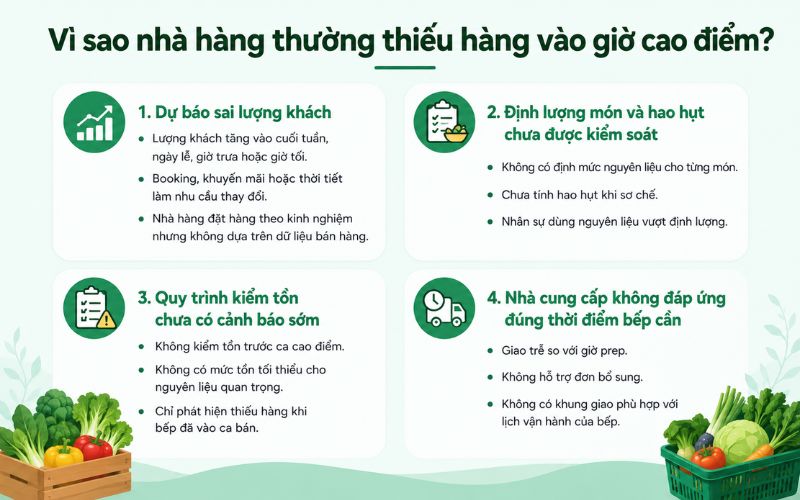
Why do restaurants often run out of food during peak hours?
Supply shortages during peak hours are a common problem for many restaurants, eateries, and F&B chains. The causes stem not only from ordering issues but also from demand forecasting, inventory management, and supplier responsiveness. Identifying the root cause will help businesses choose appropriate solutions, rather than simply increasing stock levels or constantly handling urgent deliveries.
Incorrect forecast of customer numbers.
Customer demand often fluctuates sharply on weekends, holidays, lunchtime, or in the evening. Additionally, promotions, special events, weather, or consumer trends can also cause a short-term surge in customer numbers.
Many restaurants still place orders based on the manager’s experience or intuition rather than analyzing actual sales data. This results in the amount of ingredients prepared not matching demand, leading to shortages when customer numbers exceed expectations.
The portion sizes and losses are not being controlled.
The lack of clearly defined ingredient standards for each dish is one of the common causes of product loss. When each food processor uses ingredients differently, actual consumption is often higher than initially planned.
Furthermore, many kitchens do not fully account for losses during the preparation process, such as cutting and trimming vegetables, filleting meat, or cleaning seafood. If these factors are not included in the purchasing plan, the actual inventory levels may be significantly lower than the recorded figures.
The inventory process lacks early warning.
Many restaurants only check inventory when preparing to place orders or when ingredients are running low. Failing to check inventory before peak shifts makes it difficult for operations to detect potential shortages early on.
Furthermore, without establishing minimum inventory levels for critical ingredients, restaurants lack the basis for proactively replenishing supplies. As a result, problems are only discovered when the kitchen is already in full swing, making remediation more reactive and costly.
The supplier failed to deliver the kitchen’s order on time.
Even if the restaurant forecasts and orders accurately, the risk of shortages can still occur if suppliers fail to deliver on time. Late deliveries compared to the prep timeframe can disrupt the entire kitchen’s preparation plan.
Some suppliers also do not support same-day restocking or offer flexible delivery schedules to meet operational needs. When unexpected demands arise, restaurants are forced to find alternative sources or accept reduced menu items, directly impacting revenue and customer experience.
What is the difference between expedited delivery and secure inventory?
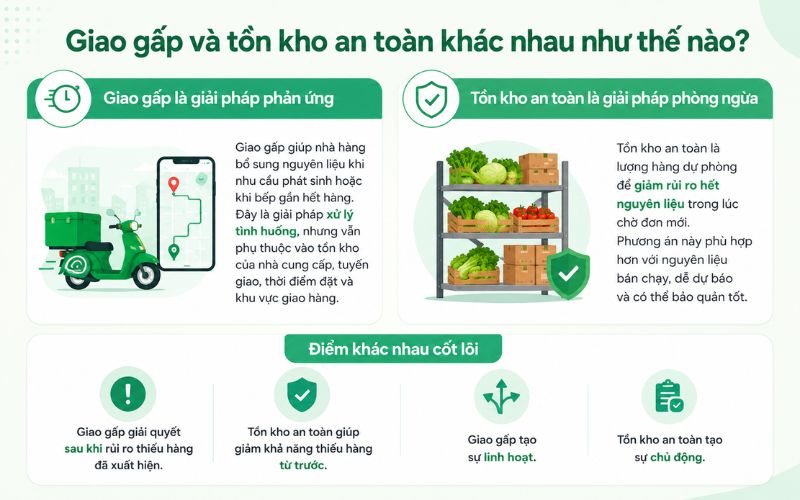
When frequently facing ingredient shortages during peak hours, many restaurants consider two common options: using express delivery services or increasing safety stock levels. Although both aim to ensure supply, these two solutions have completely different approaches and are suited to distinct operational needs.
Express delivery is a reactive solution.
Express delivery helps restaurants quickly replenish ingredients when demand spikes or when actual inventory levels are lower than expected. This is a situational solution to minimize operational disruptions and avoid having to temporarily suspend service.
However, the effectiveness of expedited delivery still depends on many factors such as the supplier’s inventory capacity, the timing of the order, the delivery route, and the service area. During peak hours or periods of high market demand, finding sufficient stock and delivering on time can become more difficult.
Safety stock is a preventative measure.
Safety stock refers to the amount of raw materials maintained as a reserve to reduce the risk of running out while awaiting replenishment orders or when actual demand exceeds forecasts. This is a proactive approach that helps restaurants maintain stable operations even during short-term fluctuations.
This solution is particularly suitable for fast-selling ingredients with relatively stable consumption and sufficiently long shelf lives. When properly managed, safety stock helps reduce pressure to place urgent orders and limits the risk of revenue loss due to ingredient shortages.
The core difference
The biggest difference between the two options lies in the timing of risk management.
- Expedited delivery is used when there is a risk of shortages or a risk of stock shortages.
- Safety stock is established in advance to reduce the possibility of stock shortages.
Operationally, expedited delivery offers flexibility when demand fluctuates unpredictably and restaurants don’t want to maintain large inventories. Meanwhile, safe-haven inventory allows businesses to be more proactive in their supply planning, reducing dependence on unforeseen circumstances and the immediate responsiveness of suppliers.
Therefore, instead of viewing these as two opposing options, many restaurants now combine both solutions: maintaining safe inventory levels for essential ingredients and using express delivery as a backup option when unexpected surges in demand occur.
Should you choose expedited delivery or safe inventory?
There is no one-size-fits-all solution for every restaurant. The choice between expedited delivery or maintaining safe inventory levels depends on the frequency of shortages, the characteristics of the ingredients, storage capabilities, and the impact on revenue. In many cases, restaurants need to combine both approaches to maintain flexibility while ensuring a stable supply.
When should I choose express delivery?
Express delivery is suitable when stock shortages only occur occasionally and do not seriously impact business operations. This solution helps restaurants quickly handle unexpected needs without constantly increasing inventory levels.
Restaurants should prioritize urgent deliveries when:
- Shortages only occur once or twice a month.
- The material is perishable and unsuitable for storage in large quantities.
- The missing dish is neither a signature dish nor a substitute.
- The supplier is able to deliver within the same day or within a few hours.
- The restaurant can flexibly adjust the menu as needed.
When is it safe to increase inventory?
If material shortages occur frequently, maintaining a safe level of inventory is often more effective than constantly responding with urgent orders.
Restaurants should consider increasing safety stock levels when:
- Shortages occur regularly, on a weekly or monthly basis.
- The ingredients belong to the group of best-selling items.
- Running out of stock significantly impacts revenue.
- There is sufficient cold storage or suitable storage space.
- Consumer demand can be predicted based on sales data.
Which product categories should have a safe level of inventory?
Not all ingredients need to be stockpiled in large quantities. Restaurants should prioritize maintaining a safe inventory of items that are essential to their operations:
- Ingredients used for best-selling or signature dishes.
- The ingredient is used in many different dishes.
- Dry goods, frozen goods, spices and sauces.
- The ingredients have a relatively long shelf life.
- Items that are in short supply will force the discontinuation of sales of essential goods.
Which product categories should be prioritized for urgent or supplementary delivery?
For ingredients with short shelf lives or requiring high freshness levels, restocking is often a better option than increasing inventory.
Suitable product categories include:
- Leafy vegetables, herbs, and mushrooms.
- Ripe fruit or ingredients that require a high degree of freshness.
- Toppings and additional ingredients can be substituted.
- Ingredients for bookings, parties, or any additional orders.
- The raw materials are valuable and should not be stored in large quantities.
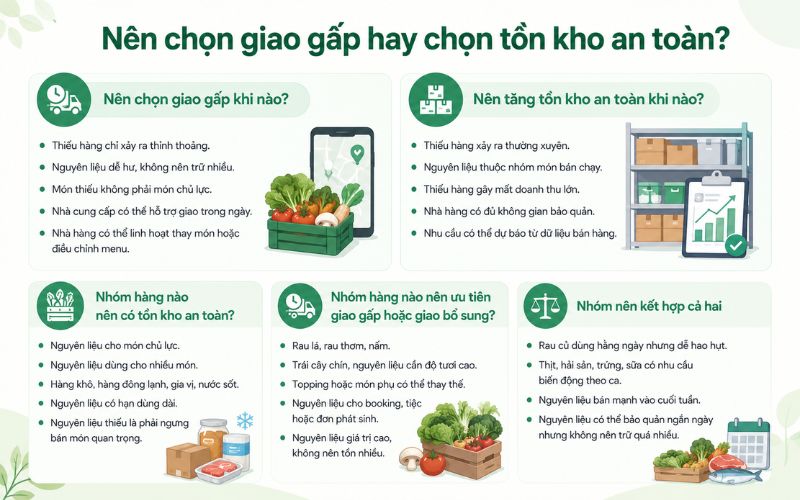
The team should combine both.
Some raw material groups have both high demand and high volatility. In this case, combining safety stock with the ability to replenish supplies is the most effective solution.
For example:
- Vegetables are used daily but have a high spoilage rate.
- The demand for meat, seafood, eggs, and dairy products varies depending on the sales shift.
- Ingredients sell well on weekends or during peak seasons.
- Ingredients can be stored for a short period, but excessive quantities should not be stockpiled.
Quick decision-making guide for restaurants
|
Real-life situation |
The preferred solution |
Reason |
|
Shortage of goods 1-2 times/month |
Urgent delivery |
There’s no need to significantly increase inventory yet. |
|
Weekly shortages |
Safe inventory |
Indicators suggesting that demand forecasts or minimum inventory levels are not appropriate. |
|
Missing best-selling items |
Safe inventory |
The cost of lost revenue is usually higher than the cost of inventory. |
|
A lack of fresh vegetables can easily cause spoilage. |
Urgent additional delivery |
Reduce the risk of wilting, bruising, and loss. |
|
Stock shortage due to unexpected bookings. |
Pre-order combined with additional express delivery |
We need both planning and flexibility. |
|
Shortage of goods due to delayed delivery from the supplier. |
Increase your reserves or switch suppliers. |
Urgent delivery cannot address the root cause. |
|
Shortage of goods due to lack of inventory check. |
Establish an inventory control procedure. |
You shouldn’t just increase the order quantity. |
|
Shortage of stock due to promotions or weekends. |
Safe inventory levels are based on sales data. |
Demand can be predicted in advance. |
Instead of blindly choosing one over the other, many restaurants now maintain a safe level of inventory for strategic ingredients and use supplemental deliveries as an extra layer of protection when demand spikes or unforeseen circumstances arise. This is often the best way to balance service capacity, inventory costs, and operational efficiency.
This checklist helps restaurants reduce stock shortages during peak hours.
Besides choosing between expedited delivery or maintaining safe inventory levels, restaurants need to establish a consistent inventory control and demand forecasting process. A simple checklist, performed regularly before, during, and after each shift, can significantly reduce the risk of stock shortages and improve the accuracy of purchasing planning.
Before the peak sales shift
After each shift, the restaurant needs to record actual data to improve the accuracy of forecasts and order planning for the following days.
The following content should be monitored:
- Inventory of key raw materials: Ensure that the ingredients for the best-selling item are sufficient to serve throughout the peak shift.
- Compare inventory with bookings and forecasts: Compare the current stock levels with the expected number of customers to identify potential shortages.
- Identify items that are at risk of running out of stock: Prioritize monitoring items that sell well or have low ingredient inventory.
- Confirm the order with the supplier: Check the delivery status to avoid issues caused by delayed or missing items.
- Prepare alternative plans: Develop a plan to substitute ingredients or adjust the menu as needed.
After the sales shift
After each shift, the restaurant needs to record real-time data to improve ordering plans and forecast future demand.
- Note the missing item: Keep track of dishes that cannot be served due to a lack of ingredients.
- Note the time when the item was out of stock: Precisely identifying the time of the incident is crucial for discovering consumption patterns.
- Analyzing the causes: Clarify whether the stock shortage is due to exceeding sales targets, high losses, insufficient orders, or delayed deliveries.
- Adjust the quantity or minimum stock level: Update management processes based on real-world data.
- Order plan update: Adjust the purchase quantity for the following day to prevent a similar situation from recurring.
Weekly
Weekly reviews help restaurants identify consumption trends and optimize their inventory management strategies.
- Check out our top-selling items: Identify which items require priority in terms of ingredient sourcing.
- Check for commonly missing ingredient groups: Identify the items that are most likely to run out of stock.
- Compare the cost of damaged goods and the cost of out-of-stock items: Assess whether the current inventory level is reasonable.
- Assess supplier reliability: Check the on-time delivery rate and the ability to fulfill outstanding orders.
- Update the safe stock list: Replenish or adjust the required materials to maintain minimum inventory levels.
Consistently implementing this checklist will significantly reduce the risk of stock shortages during peak hours, while also achieving a better balance between inventory costs and customer service capacity.
How does Kamereo help restaurants address the problem of insufficient staff during peak hours?
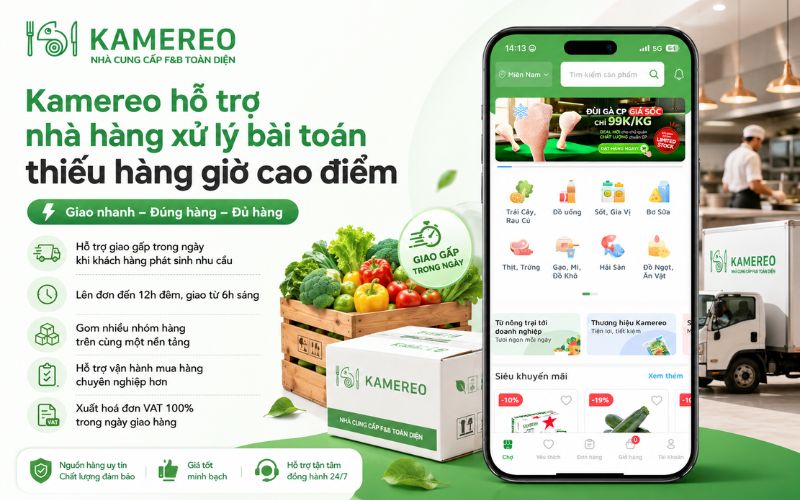
When customer demand spikes or forecasts deviate, quickly replenishing supplies can help restaurants avoid operational disruptions and limit lost revenue. Kamereo is a wholesale food supply app that provides a centralized purchasing solution, helping F&B businesses be more proactive in handling unexpected supply shortages.
We offer same-day express delivery upon customer request.
In reality, many restaurants run out of ingredients mid-shift due to higher-than-expected customer numbers, unexpected events or large bookings, or insufficient deliveries from current suppliers. To help handle these situations, Kamereo offers same-day delivery for orders placed before 10 AM, subject to delivery area, inventory availability, and actual dispatch capacity.
- Support for handling unexpected needs: Help the restaurant replenish its supplies when unexpected needs arise.
- Order online quickly: Orders can be placed directly on the website or app.
- Track your order status: Easily track processing and delivery progress on a single platform.
Orders can be placed until 12 AM, and deliveries start at 6 AM.
Besides its ability to support express deliveries, Kamereo is also suitable for the daily inventory needs of restaurants.
- Applications accepted until 23:59: Restaurants can place orders before 23:59 local time, and orders are expected to be delivered the next day (D+1), allowing for better control over demand and adjustment of ordering plans.
- Delivery starts from 6:00 AM: Customers can choose a convenient delivery time slot between 6:00 AM and 6:00 PM, making it easier for the kitchen to schedule delivery, preparation, and cooking before serving customers.
- Maintain a stable supply: This helps reduce the pressure of preparing materials at the beginning of the day, while also limiting the risk of operational disruptions due to delayed deliveries or shortages.
Group multiple product categories on the same platform.
Instead of working with multiple suppliers for each ingredient group, Kamereo helps restaurants purchase a diverse range of items on a single platform. From vegetables, meat, seafood, eggs, and dairy to dry goods, spices, and kitchen supplies, businesses can order everything in a single order.
By centralizing sourcing through a single partner, the restaurant reduces the time spent searching for and working with multiple suppliers, while simplifying the ordering process, tracking deliveries, and reconciling documents. This solution helps the purchasing department save time, operate more efficiently, and better control costs.
Support for more professional purchasing operations.
In addition to providing suppliers, the Kamereo ordering app also supports businesses in standardizing their procurement processes by:
- Store your order history: It’s easy to review purchasing data to make more accurate demand forecasts.
- Track your order status in real time: Reduce the risk of information loss when working with multiple sources.
- Better cost control: The reporting system helps businesses track and analyze the cost of goods purchased.
- Manage multiple branches using the same account: Suitable for restaurant chains or models with multiple outlets.
100% VAT invoice will be issued on the day of delivery.
Besides a stable supply of goods, documentation is also very important for F&B businesses.
- We issue VAT invoices for all orders: To help businesses with accounting and tax filing more conveniently.
- Invoices will be issued on the same day of delivery: This includes weekends and holidays.
- Storing electronic invoices on the system: Easy to look up and cross-check when needed.
If your restaurant frequently runs out of ingredients during peak hours, start by identifying which items need to be stocked and which can be reordered. For planned or on-demand wholesale food procurement, Kamereo is a worthwhile solution to optimize your purchasing process, reduce the risk of stockouts, and maintain stable business operations.
Conclude
Restaurants should avoid making extreme choices between rush delivery and safe stocking. Rush delivery is suitable for handling sudden demands, while safe stocking reduces the risk of ingredient shortages and ensures stable operations during peak hours. Over-reliance on either solution can increase costs or negatively impact operational efficiency.
To minimize stock shortages, restaurants should categorize ingredients by importance, shelf life, and frequency of use. Essential ingredients should be kept in safe stock levels, while perishable items or those requiring additional orders can be restocked. With flexible wholesale food sourcing and a stable supply, Kamereo is a worthwhile solution to optimize purchasing processes and reduce the risk of stockouts.