

 0812 46 37 27




Receiving beverage deliveries for restaurants involves more than just counting the quantity; it also requires checking the condition of the cans/bottles, volume, expiration date, and accompanying documentation. A rigorous inspection process helps restaurants minimize losses, detect errors immediately upon delivery, and ensure the quality of ingredients before storage or use.
Why do restaurants need a beverage receiving checklist?
Creating a beverage receiving checklist helps restaurants control the quality of incoming goods, minimize errors during the warehousing process, and ensure accurate inventory data. For F&B businesses with many product codes, multiple branches, or frequent deliveries, a standardized inspection process also helps reduce losses and save time in handling errors.
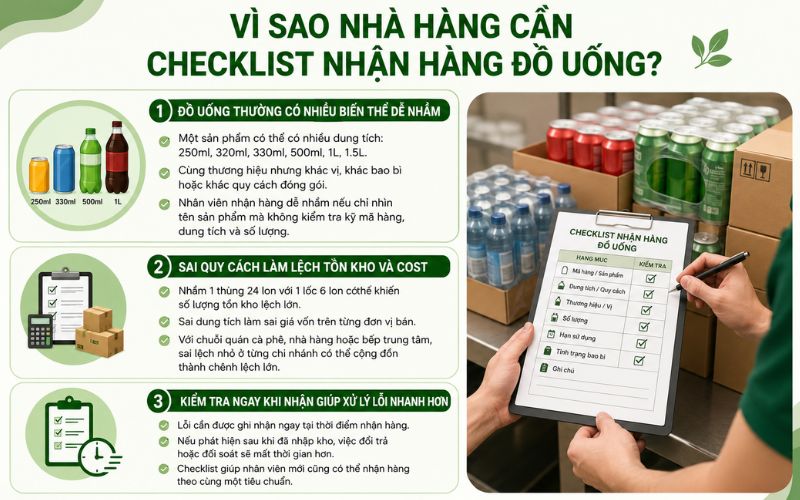
The drinks often have many variations that can easily be confused.
Beverages are a product category with many different versions even under the same brand. A single product can be distributed in various sizes such as 250ml, 320ml, 330ml, 500ml, 1L, or 1.5L, and may also differ in flavor, packaging design, or packaging specifications.
If employees only check the product name without carefully verifying the product code (SKU), volume, and quantity, it’s easy to mistake the version. This error can lead to incorrect goods matching the order, affecting sales, inventory management, and cost accounting.
Incorrect specifications lead to discrepancies in inventory and costs.
Confusing packaging specifications is one of the common mistakes when receiving beverages. For example, recording a case of 24 cans as a pack of 6 cans will create a significant discrepancy in inventory quantities right from the first delivery.
Furthermore, incorrect volume measurements alter the cost per unit sold, leading to inaccurate beverage cost calculations. For coffee chains, restaurants, or central kitchens with multiple outlets, small discrepancies at each branch can accumulate into significant differences in inventory and raw material cost reports.
Checking immediately upon receipt helps resolve errors faster.
Detecting errors at the time of delivery allows the restaurant to quickly resolve issues with the supplier while all goods, documents, and delivery information are still available. Errors in quantity, volume, packaging specifications, or product condition should be recorded and confirmed before finalizing the acceptance of the goods.
Conversely, if defects are only discovered after the goods have been received or put into use, the process of reconciliation, exchange, or verification of the cause will take more time and effort. A clear beverage receiving checklist also helps new employees follow the correct procedures, ensuring that all batches are inspected according to the same standards, reducing reliance on individual experience.
Information to be verified before signing for drinks.
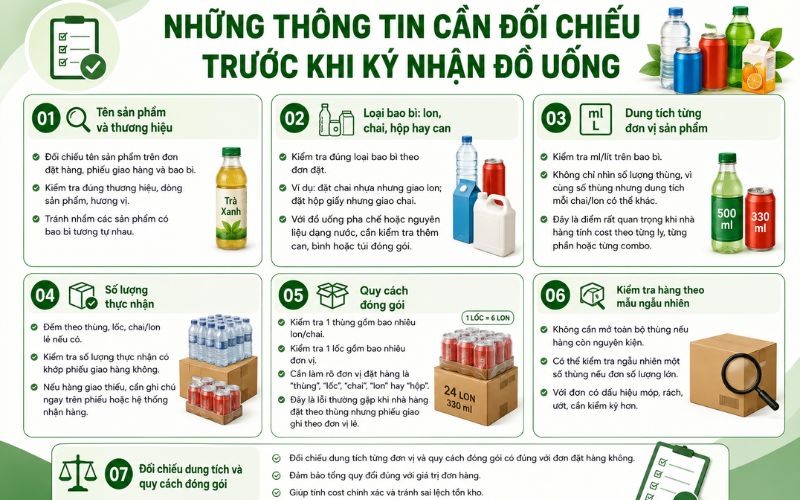
Before signing to acknowledge receipt of goods, the restaurant needs to thoroughly compare the information between the order, the delivery slip, and the actual goods. This verification step helps to detect early any errors in type, volume, specifications, or quantity, avoiding impacts on inventory and operating costs.
Product name and brand
The product name is the first piece of information that needs to be checked to ensure the supplier delivers the correct item ordered.
The following information needs to be cross-checked:
- The product name on the order form, delivery note, and packaging must be consistent.
- Verify the correct brand, product line, and flavor.
- Confirm the correct product version if there are multiple options from the same brand.
- Pay particular attention to products with similar packaging or colors to avoid confusion.
Type of packaging: can, bottle, box, or container
The same type of beverage can be packaged in many different ways. Therefore, it is necessary to check that the correct packaging matches the information on the order.
The following information needs to be compared:
- Verify the correct type of packaging: can, bottle, cardboard box, container, or bag.
- Check for cases where orders are placed for plastic bottles but cans are delivered, or orders are placed for cardboard boxes but bottles are delivered.
- For liquid ingredients such as syrups, concentrated juices, or sauces, it’s essential to check that the correct container, bottle, or pouch is used for packaging.
Unit volume
Volume directly affects the cost and quantity when preparing or serving drinks.
When conducting the inspection, the following is required:
- Compare the volume indicated on the packaging (ml or liters).
- Don’t just check the number of cases because even with the same number of cases, the capacity of each can or bottle can be different.
- Ensure the actual volume matches the product ordered.
- Carefully check items that come in multiple sizes such as 250ml, 330ml, 500ml, 1L, or 1.5L.
This step is especially important if the restaurant charges per drink, per portion, or per combo.
Actual number received
After confirming the product is correct, check the actual quantity before signing for receipt
.
The steps involved include:
- Count the quantity by carton or pack.
- Check the number of individual bottles, cans, or containers if they are being delivered separately.
- Compare the actual quantity received with the delivery slip.
- Record any instances of underdelivery or overdelivery immediately.
- Clearly indicate any discrepancies on the delivery slip or receiving system for easy reconciliation.
Packaging specifications
Checking the packaging specifications helps avoid confusion regarding units of measurement and actual quantities.
Confirmation needed:
- How many cans or bottles are in a box?
- A pack containingHow many units?
- The order unit is a carton, pack, bottle, can, or box.
- Does the actual packaging match the information on the order and delivery slip?
This is a fairly common mistake when restaurants order in bulk, but…The delivery note or invoice is recorded in odd units.
Inspect goods using a random sample.
It’s not always necessary to open the entire package, but it’s still advisable to physically inspect it to assess the quality of the shipment.
The following testing method can be applied:
- There’s no need to open all the boxes if the contents are still sealed.
- Randomly select a number of boxes or packs for inspection when the order is large.
- Inspect the packaging, quantity, and contents of the opened sample.
- If you find any boxes that are dented, torn, wet, or show signs of impact, carefully inspect all related items before accepting them.
Compare the volume and packaging specifications.
Even if the product name and quantity are correct, the restaurant should still double-check the volume and packaging specifications, as these are two factors that are easily subject to discrepancies during inventory management.
The following information needs to be confirmed:
- The actual volume of each bottle, can, or container matches the order.
- The packaging specifications, such as the number of cans/bottles in each pack or carton, are accurate.
- The unit of measurement on the delivery note is consistent with that of the ordering unit.
- The total converted quantity after verification matches the quantity needed for warehousing.
Comparing these two pieces of information thoroughly helps restaurants minimize inventory discrepancies, accurately calculate cost of goods sold, and avoid disputes with suppliers after the goods have been received.
Checklist for receiving beverage orders for restaurants.
To minimize errors during inventory receiving, restaurants should implement a standardized beverage receiving checklist for all staff. Checking each item before signing for receipt helps detect errors promptly, reduces losses, and ensures accurate inventory data.
| Inspection items | What needs to be checked? | Notes when errors are detected |
|---|---|---|
| Product name | The correct name, brand, and product line as per the order. | Clearly indicate the incorrect product delivered on the delivery slip or in the system. |
| Packaging type | The correct type of can, bottle, box, container, or bag as ordered. | Take photos of the packaging and record them for verification with the supplier. |
| Capacity | Correct volume (ml/liter) as ordered. | Do not accept or request confirmation if incorrect volume affects cost of goods sold. |
| Quantity | The correct number of cartons, packs, bottles, or cans actually received. | Clearly indicate any shortages or surpluses before signing for receipt. |
| Packaging specifications | The correct number of cans/bottles in each carton or pack. | Check the units of measurement on the delivery note and order form. |
| Packaging condition | The packaging is intact, without dents, tears, breaks, or leaks. | Separate the defective items and create a report if necessary. |
| Expiry | Still within expiration date and in line with consumption plan. | Do not import goods that are nearing their expiration date without prior agreement. |
| Product label | It includes the full product name, manufacturer, expiration date, storage instructions, and other required information. | Carefully check imported goods or goods labeled by the distributor. |
| Delivery note | The information on the receipt matches the goods actually received. | Only sign the confirmation after the inspection is complete. |
| Invoices and receipts | In full compliance with the agreement with the supplier. | Retained for debt reconciliation and accounting purposes. |
For packaged food and beverage items or products requiring warehousing, restaurants should simultaneously cross-check the actual goods, delivery notes, invoices, product labels, expiration dates, and storage conditions. Completing these steps helps reduce the risk of incorrect inventory, facilitates traceability in case of problems, and ensures consistent inventory management.
Download the free beverage receiving checklist for restaurants now to print or use directly in your inventory process, helping staff with inventory control. Please ensure all items are complete before signing and minimize errors as much as possible.
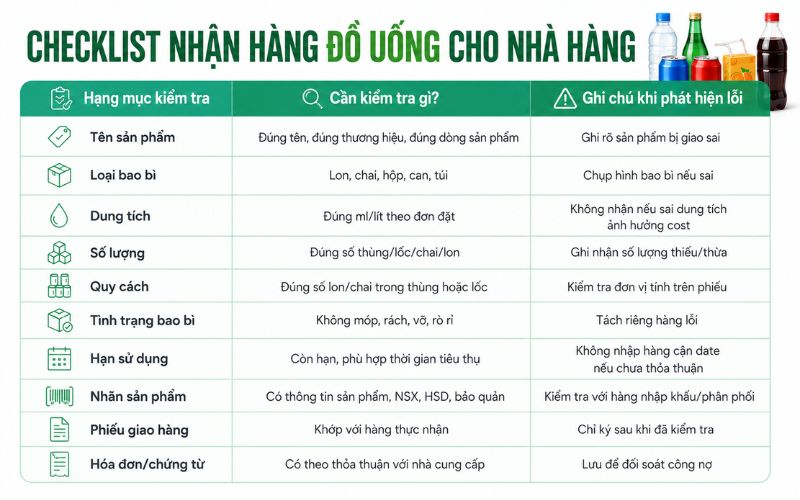
Standard beverage ordering procedure for restaurants.
A clear receiving process helps restaurants control the quality of incoming goods, minimize errors during warehousing, and facilitate reconciliation with suppliers. Below is a five-step process that can be applied to most restaurant, cafe, and central kitchen models.
Step 1: Prepare your order before receiving it.
Before the delivery vehicle arrives, the responsible staff member should have all the necessary information ready so that the inspection process can be quick and accurate.
The tasks to be performed include:
- Print the order form or open it on your phone, tablet, or computer.
- Please check the list of products you will receive that day.
- Identify easily confused product codes, such as those from the same brand but with different sizes, flavors, or packaging.
- Prepare a checklist for receiving goods if the restaurant uses a standardized inspection procedure.
- Assign staff members to be directly responsible for receiving and signing for the goods.
Step 2: Compare the delivery slip.
When the supplier delivers the goods, the information on the delivery slip should be compared with the order before conducting a physical inspection.
The items to be checked include:
- Product name.
- Brand and product line.
- Quantity.
- Unit of measurement ( thùng, lot, bottle, can, or box).
- Packaging specifications.
- Any special notes, if applicable.
If the information on the delivery slip differs from the order, you must contact the supplier for confirmation before signing for receipt or warehousing.
Step 3: Inspect the goods in person.
After verifying the documents, a physical inspection of the goods will be conducted to ensure they match the order details.
The examination content includes:
- Count the actual number of cartons, packs, and individual units received.
- Check the volume of each product against the packaging.
- Check the packaging specifications of each carton or pack.
- Inspect the condition of cans, bottles, boxes, or containers for dents, leaks, or damage.
- Check the expiration date and product label.
- Some boxes may be opened randomly for large orders or when there are signs of irregularities.
Only when the goods and documents match should you proceed to the next step.
Step 4: Record defective or mismatched goods.
If any discrepancies are found during the inspection process, they should be noted immediately to facilitate smooth resolution with the supplier.
The processing steps include:
- Take photos of the defective product or packaging as evidence.
- Make notes directly on the delivery slip or in the receiving management system.
- Separate substandard goods to avoid mistakenly receiving them into the warehouse.
- Agree with the supplier on a solution such as exchanging goods, delivering replacements, adjusting quantities, or offsetting outstanding debts.
- Save all images and records (if any) for future verification.
Step 5: Sign and save the document.
After completing the inspection and correcting any discrepancies (if any), the restaurant will proceed to sign for receipt of the goods.
The following tasks need to be performed:
- Only sign after all inspection steps have been completed.
- Keep the delivery slip along with the invoice and related documents.
- Regularly compare supporting documents with inventory data and accounts payable records.
- For a chain of restaurants or cafes with multiple branches, records should be kept as follows:
- Delivery date.
- Receiving branch.
- Supplier.
- Delivery slip number or order number.
Maintaining complete documentation makes it easier for restaurants to retrieve information, reconcile accounts payable, and handle complaints or internal audits.
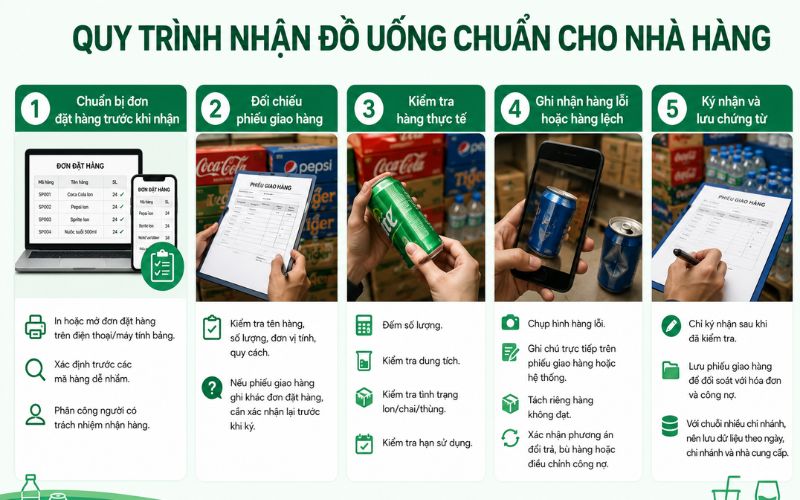
Criteria for selecting beverage suppliers to reduce delivery errors.
Besides establishing a rigorous inspection process, choosing a reputable beverage supplier is also a crucial factor in helping restaurants minimize errors during the warehousing process. A supplier with transparent product information, a clear delivery process, and a professional management system will significantly reduce errors in product codes, quantities, and documentation.
The product has clear specifications.
The more detailed the product information, the easier it is for the purchasing team and receiving staff to verify, minimizing errors during ordering and receiving.
- The price quote includes all specifications: Clearly state the selling unit (case, pack, bottle, can), volume, and packaging specifications to avoid misunderstandings when placing an order.
- The image accurately represents the actual product: The packaging displayed on the quotation or system must match the delivered goods, making it easy for staff to identify them.
- Transparent product data: Each product should have a clear product code (SKU), name, volume, and specifications so that the purchasing team doesn’t order the wrong version.
Delivery was on time and complete.
Suppliers need to ensure accuracy in every order to reduce the time spent checking and correcting errors.
- Deliver the correct item code: The product must be of the correct brand, product line, flavor, and volume as ordered.
- Ensure sufficient quantity: The actual quantity delivered must match the order and the delivery note.
- There is a process for handling errors: The regulations clearly state how to exchange, return, or adjust accounts payable when shortages or incorrect deliveries occur.
- Suitable delivery time frame: Delivery times should accommodate the kitchen or bar’s operating schedule to avoid disrupting business operations.
Delivery slips and invoices are transparent.
Complete documentation helps restaurants easily control inventory, reconcile accounts payable, and account for expenses.
- The delivery slip is clear: Show the full product name, quantity, unit of measurement, specifications, and delivery date.
- Invoices and supporting documents are complete: Provided as agreed for accounting and record-keeping purposes.
- Consistent information: The content on invoices, delivery notes, and purchase orders needs to be consistent to minimize discrepancies during reconciliation.
- Support for cost control: Transparent documentation helps F&B businesses track cost of goods sold, accounts payable, and transaction history more accurately.
There is an order placement and history lookup system.
Applying technology to the purchasing process helps reduce errors arising from manual transactions and improves management efficiency.
- Order on a unified platform: Minimize the risk of information loss when exchanging messages over multiple calls or texts.
- Check your order history: Easily review your purchased products, quantity, price, and delivery time.
- Track your delivery history: Assist in reviewing previous deliveries before reconciliation or complaint processing is needed.
- Suitable for multiple people to participate at the same time: Multiple personnel, including those in purchasing, warehouse management, and accounting, can monitor data together, leading to a more synchronized and transparent workflow.
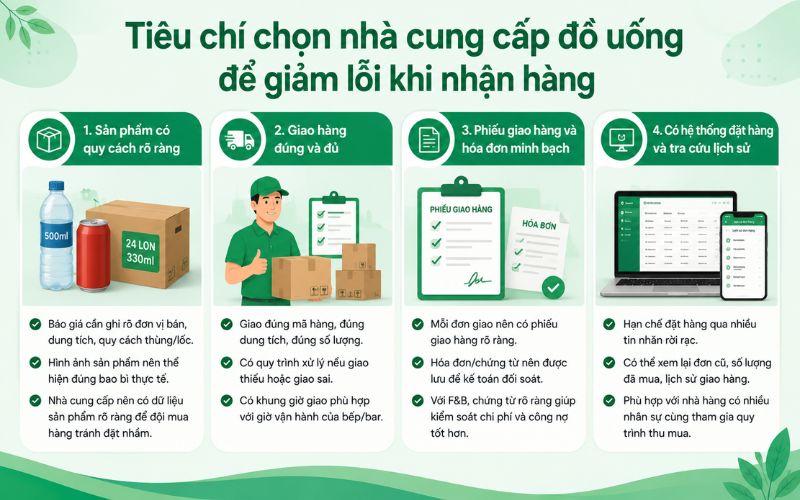
How does Kamereo help restaurants manage wholesale beverage and food orders more easily?
For restaurants, cafes, and central kitchens, controlling the quality of ingredients depends not only on the receiving process but also on the capabilities of the supplier. Kamereo has built a closed-loop supply chain from warehousing, quality control, delivery, to documentation, helping F&B businesses minimize risks with each order.
HACCP certified warehouse and 4-layer quality control process.
To ensure consistent quality of beverages and food before delivery to customers, Kamereo employs a multi-layered quality control process combined with a warehousing system that meets food safety standards.
Key highlights include:
- Quality control from the supply source: The product is inspected right from the farm or partner supplier before being released into the supply chain.
- Inspection at the purchasing center: Goods are assessed for quality, condition, and input standards before shipment.
- Inspection at the coordination center: After being transported to the warehouse, the products are further sorted and inspected to ensure uniformity before shipment.
- Final check before delivery: Each order is reviewed before delivery to the customer, helping to minimize defective goods or incorrect product deliveries.
- Storage facility meets HACCP standards: The warehouse system is designed with appropriate storage areas for each product group, helping to maintain product quality throughout the storage and transportation process.
Thanks to the multi-layered quality control process, restaurants can be more confident about the quality of goods right from the receiving stage, while reducing inspection time and the rate of complaints.
Check the goods together with the shipper upon receipt.
Kamereo applies this form joint inspection upon delivery. This helps restaurants verify the quality and quantity of products at the time of receipt.
This process offers several benefits:
- Check the product directly with the shipper: The restaurant can compare the product with the order upon delivery.
- Timely error detection: It’s easy to identify cases of incorrect product codes, wrong quantities, missing items, or damaged packaging.
- Quick on-site treatment: If a problem is discovered, both parties can confirm it immediately without having to wait for the complaint process after the goods have been received.
- Reduce reconciliation risk: Checking the product before signing helps to minimize disputes and save processing time later on.
For orders containing multiple types of beverages or food items, joint verification also helps warehouse staff easily cross-check against the checklist and complete the receiving process faster.
Clear return and exchange policy in case of product defects.
In the F&B industry, promptly handling defective goods helps minimize operational disruptions and avoid impacting food preparation or customer service plans.
Kamereo has established a transparent return policy with the following highlights:
- Return or exchange immediately upon receipt: The restaurant may request a return or exchange if the product is found to be unsatisfactory during the inspection process.
- Reduce complaint processing time: No further verification steps are needed after goods have been received in the warehouse.
- Fast processing support: This helps businesses quickly find solutions for exchanging or replenishing goods so that their business operations are not affected.
- Increase transparency: A clear handling process makes it easy for both the restaurant and the supplier to track issues when they arise.
As a result, restaurants can significantly reduce the risk of receiving substandard goods or spending a lot of time processing them after they have been received into inventory.
Complete and transparent VAT invoices for easy verification.
Besides product quality, complete documentation is also a crucial factor in helping F&B businesses manage costs and accounts receivable effectively.
Kamereo supports:
- We issue VAT invoices for all orders: Ensuring legality and transparency in the buying and selling process.
- Invoices will be issued on the same day of delivery: This includes weekends and holidays, saving businesses from long waiting times.
- Send electronic invoices automatically: The invoice is sent via email and saved to the purchase account, reducing the risk of losing the receipt.
- Convenient for reconciling accounts payable: Accountants can easily reconcile purchase orders, delivery notes, and invoices to control costs.
- Long-term management support: The transaction data is stored centrally, making it convenient for retrieving transaction history or for use in audits and tax declarations.
For restaurants with multiple branches or those that import goods frequently, a transparent documentation system helps to speed up the reconciliation process, making it more accurate and significantly reducing the workload for the accounting department.
Summary
Receiving beverage deliveries for restaurants is a crucial step in controlling input quality, minimizing inventory discrepancies, and ensuring the accuracy of cost pricing. Implementing a checklist and a standardized receiving process will help restaurants detect errors at the point of delivery and optimize inventory management.
If you’re looking for a wholesale food and beverage supplier with a stable supply chain, rigorous quality control, on-time delivery, and transparent documentation, Kamereo is a worthwhile solution to simplify your F&B procurement and operations. Discover Kamereo today to optimize your sourcing process and manage your raw materials more effectively.
See more: